


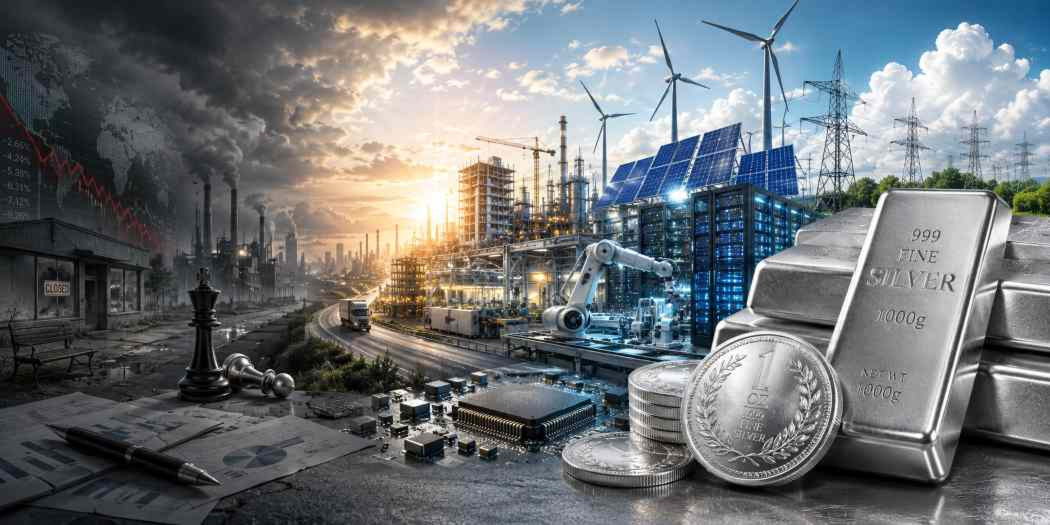
Economic Recoveries Often Reveal a Different Side of the Silver Market
When economies begin to recover, investors naturally gravitate toward familiar signals. They watch employment figures improve, manufacturing activity stabilize, and consumer confidence gradually return. Equity markets often respond first, followed by industrial commodities as factories increase production and businesses begin investing again. Silver, however, occupies an unusual place within that progression. It rarely attracts the same attention as gold during periods of crisis, yet history shows that some of its strongest advances have occurred after the worst of the uncertainty has already passed.
That tendency has less to do with investor psychology than with silver's unique position in the global economy. Few assets respond to both financial confidence and industrial expansion in the way silver does. As recession fears begin to fade, manufacturers increase orders for raw materials while investors who accumulated defensive positions start looking for opportunities with greater upside potential. Silver often benefits from both developments simultaneously, allowing it to participate in a phase of the market that gold does not always dominate.
The distinction is particularly relevant today. Global investment continues flowing into artificial intelligence infrastructure, renewable energy, advanced electronics, and electrical grid modernization, all of which require substantial amounts of silver. At the same time, many investors remain focused on inflation, government debt, and long-term monetary uncertainty. Rather than competing with one another, these forces are creating multiple avenues of demand that have the potential to reinforce one another as economic activity strengthens.
Understanding why silver has historically outperformed during recoveries requires looking beyond silver spot price charts. The more revealing story lies in how the metal's character changes as economies transition from preservation to expansion.
Recovery Changes the Conversation From Safety to Growth
The earliest stages of an economic downturn tend to favor assets associated with stability. Investors reduce exposure to cyclical industries, corporate earnings become less predictable, and preserving capital often takes priority over pursuing higher returns. Gold has traditionally benefited from those conditions because its primary role is tied to monetary confidence and wealth preservation rather than industrial consumption.
Silver follows a different path.
Although it shares many monetary characteristics with gold, silver begins attracting broader interest once investors believe the economic outlook is improving. Confidence encourages manufacturers to expand production, utilities resume infrastructure projects, and technology companies accelerate capital spending. Those decisions increase physical demand for silver while financial markets simultaneously become more willing to embrace higher-volatility assets.
Historically, that combination has created an environment in which silver can close the performance gap with gold and, in many cases, move beyond it. The transition is rarely immediate, nor is it guaranteed in every recovery. Yet the pattern has appeared often enough across multiple market cycles that experienced commodity investors pay close attention whenever economic momentum begins shifting from contraction toward expansion.
This dual response distinguishes silver from many other precious metals. It is influenced not only by investor expectations but also by the pace at which the real economy begins consuming raw materials again. Recoveries therefore introduce a second layer of demand that becomes increasingly important as confidence broadens across financial markets.
Industrial Demand Gives Silver an Advantage Few Precious Metals Share
Every economic recovery develops its own identity. Some are driven by housing, others by manufacturing, technology, infrastructure spending, or consumer demand. What remains remarkably consistent is that silver finds its way into many of the industries that expand during those periods.
Its conductivity, durability, and chemical properties make it essential in products ranging from electrical components and medical equipment to solar panels, semiconductors, automotive electronics, and advanced communications systems. As businesses begin investing again after periods of economic caution, demand for these products often increases alongside broader industrial activity.
That relationship has become even more significant over the past decade. Modern recoveries are no longer defined solely by higher factory output or stronger retail spending. They are increasingly shaped by electrification, digital infrastructure, artificial intelligence, and renewable energy investment. Each of those themes carries meaningful implications for silver consumption because they depend on technologies where performance and efficiency matter as much as production volume.
In other words, today's silver market is participating in an economy that looks fundamentally different from those of previous decades. Manufacturing remains important, but technological investment has become an equally powerful source of demand. That broader foundation helps explain why many analysts now evaluate silver through multiple lenses rather than viewing it simply as an industrial metal or a lower-priced alternative to gold.
The result is a demand profile that becomes increasingly resilient as economic recoveries mature. Instead of relying on a single sector to drive prices, silver benefits from a collection of industries that often accelerate together when business confidence improves.
Investor Confidence Often Amplifies Silver's Moves
Another reason silver has historically performed well during recoveries is that investor behavior tends to evolve alongside improving economic conditions. During periods of severe uncertainty, preserving capital usually takes precedence over seeking higher returns. Once markets begin showing signs of stabilization, however, that mindset gradually changes.
Investors who previously concentrated on defensive positions often start looking for assets capable of participating more aggressively in an expanding economy. Silver frequently enters that conversation because it offers exposure to both precious metals and industrial growth. While gold remains an important portfolio hedge, silver has historically demonstrated a greater capacity for larger percentage moves once confidence returns to financial markets.
This dynamic is not simply the result of speculation. Silver's market is considerably smaller than gold's, meaning shifts in investment demand can have a proportionally greater impact on prices. Exchange-traded products, institutional allocations, and retail investment can collectively create momentum that reinforces improving industrial fundamentals. When those forces align, silver's price movements often become more pronounced than those of many other commodities.
That volatility is not without risk, and recoveries are rarely smooth. Economic growth can slow unexpectedly, monetary policy can shift, and geopolitical events can interrupt improving market sentiment. Even so, silver's historical tendency to respond strongly during expanding economic conditions reflects the way investment demand and physical consumption often reinforce one another rather than compete.
Today's Recovery Looks Different—But Silver's Role May Be Even Stronger
Every recovery reflects the challenges that preceded it, and today's environment is shaped by forces that did not exist during previous commodity cycles. Artificial intelligence is driving unprecedented investment in data centers. Governments around the world are committing billions of dollars to electrical grid upgrades and domestic manufacturing. Renewable energy projects continue expanding, while advanced electronics are becoming increasingly integrated into nearly every aspect of modern life.
Each of these developments requires materials capable of delivering high electrical conductivity and long-term reliability. Silver remains one of the few metals positioned at the intersection of all these structural trends.
At the same time, the investment case for silver has not disappeared. Questions surrounding government debt, inflation, fiscal policy, and monetary stability continue encouraging investors to maintain exposure to tangible assets. Rather than forcing investors to choose between industrial growth and wealth preservation, silver increasingly offers participation in both themes simultaneously.
That combination is one reason many analysts believe future recoveries may not follow historical patterns exactly. The underlying principle remains familiar—economic expansion tends to strengthen silver demand—but the breadth of industries now consuming the metal is considerably wider than it was twenty or thirty years ago. Instead of relying heavily on traditional manufacturing alone, silver is benefiting from technological transformations that appear likely to continue for years.
Supply Constraints Could Magnify Future Recoveries
Demand is only one side of the equation. The speed at which supply can respond often determines whether stronger consumption translates into sustained price appreciation.
Silver production faces a challenge that distinguishes it from many other commodities. A significant portion of global mine output comes as a byproduct of mining for copper, lead, zinc, and gold rather than from primary silver mines. That means production decisions are frequently influenced by conditions in other commodity markets instead of silver prices alone.
This creates an unusual dynamic during economic recoveries. Industrial demand for silver can strengthen relatively quickly as manufacturing, infrastructure, and technology spending accelerate, yet additional supply may take considerably longer to reach the market. New mining projects require years of exploration, permitting, financing, and construction before they begin producing meaningful quantities of metal.
While no commodity is immune to cyclical fluctuations, this limited supply flexibility helps explain why silver has occasionally experienced powerful advances during periods of expanding economic activity. Strong demand alone does not guarantee higher prices, but when increasing consumption meets constrained production growth, market balances can tighten more quickly than investors initially expect.
Silver's Next Opportunity May Depend on the Quality of the Recovery
The question facing investors today is not whether silver has performed well during past recoveries. Historical evidence suggests that it often has. The more important question is whether the current economic expansion shares enough characteristics with previous cycles to produce a similar outcome.
Several factors suggest the comparison deserves careful attention. Manufacturing investment is gradually broadening beyond traditional industries. Artificial intelligence continues driving demand for advanced computing infrastructure. Electrification remains a long-term priority for governments and utilities, while central banks and investors alike continue paying close attention to inflation, interest rates, and portfolio diversification.
None of these themes guarantees that silver will outperform in the months ahead. Commodity markets remain influenced by monetary policy, currency movements, global growth expectations, and investor sentiment. Short-term volatility should be expected, particularly in a market as dynamic as silver.
Yet viewed through a longer lens, silver appears unusually well positioned. It remains one of the few assets capable of benefiting from renewed industrial activity while continuing to attract investors seeking tangible stores of value. As economic recoveries gather momentum, that combination has historically proven powerful—and it may once again become one of the defining characteristics of the next phase of the commodity cycle.
FAQs
Why does silver often outperform during economic recoveries?
Silver often performs well during economic recoveries because it benefits from both investment demand and industrial consumption. As confidence returns, manufacturers increase production while investors seek assets with greater growth potential than traditional safe havens. This combination creates multiple sources of demand that can support stronger price performance than many other precious metals during expanding economic conditions.
Why is silver considered both an industrial and precious metal?
Silver occupies a unique position because it serves as both a store of value and an essential industrial material. It is widely used in electronics, renewable energy, medical technology, semiconductors, and electrical infrastructure while also attracting investors seeking portfolio diversification and inflation protection. This dual role allows silver to respond to a broader range of economic conditions than most commodities.
Does silver usually outperform gold during recoveries?
Silver has historically outperformed gold during many economic recoveries, although this is not guaranteed. Gold often leads during periods of heightened uncertainty because of its safe-haven status, while silver tends to benefit later as manufacturing, industrial activity, and investor confidence improve. The differing demand profiles help explain why their performance can diverge throughout market cycles.
How does industrial demand influence silver prices?
Industrial demand is one of the primary drivers of silver prices because the metal is essential in products such as solar panels, electrical components, semiconductors, batteries, and medical devices. As manufacturing and infrastructure spending increase during economic recoveries, silver consumption often rises alongside broader industrial production.
Why is silver important for artificial intelligence infrastructure?
Artificial intelligence depends on advanced data centers, high-performance computing systems, networking equipment, and electrical infrastructure, all of which require highly conductive materials. Silver's exceptional electrical conductivity makes it valuable in many of these technologies, supporting long-term industrial demand as AI infrastructure continues expanding.
Can supply constraints affect silver prices?
Yes. Much of the world's silver is produced as a byproduct of mining other metals rather than from primary silver mines. Because production often depends on activity in other mining sectors, supply cannot always respond quickly when demand increases. This limited flexibility can contribute to tighter market conditions during periods of strong industrial growth.
What economic indicators should silver investors watch?
Silver investors should monitor manufacturing activity, industrial production, inflation, Federal Reserve policy, interest rates, renewable energy investment, technology spending, and global economic growth. These factors influence both investment demand and physical consumption, making them important indicators for the silver market.
Is silver more volatile than gold?
Yes. Silver typically experiences larger price swings than gold because its market is smaller and influenced by both industrial demand and investor sentiment. This higher volatility can create greater upside potential during strong economic recoveries, but it also increases short-term risk during periods of economic uncertainty.
Why is silver attractive in a diversified portfolio?
Silver offers diversification because it responds to different economic drivers than many traditional financial assets. Its combination of monetary value and industrial use provides exposure to both defensive and growth-oriented market themes, making it a useful complement to stocks, bonds, and other precious metals.
Could today's recovery create another strong cycle for silver?
While no outcome is guaranteed, today's recovery differs from previous cycles because it is being supported by artificial intelligence, electrification, renewable energy, and infrastructure investment alongside traditional manufacturing. These long-term trends could continue supporting silver demand even as economic conditions evolve, giving the metal a broader foundation than in many previous recoveries.
Related reading you may find interesting:
Why Palladium Investing Is Back on Investors' Radar