


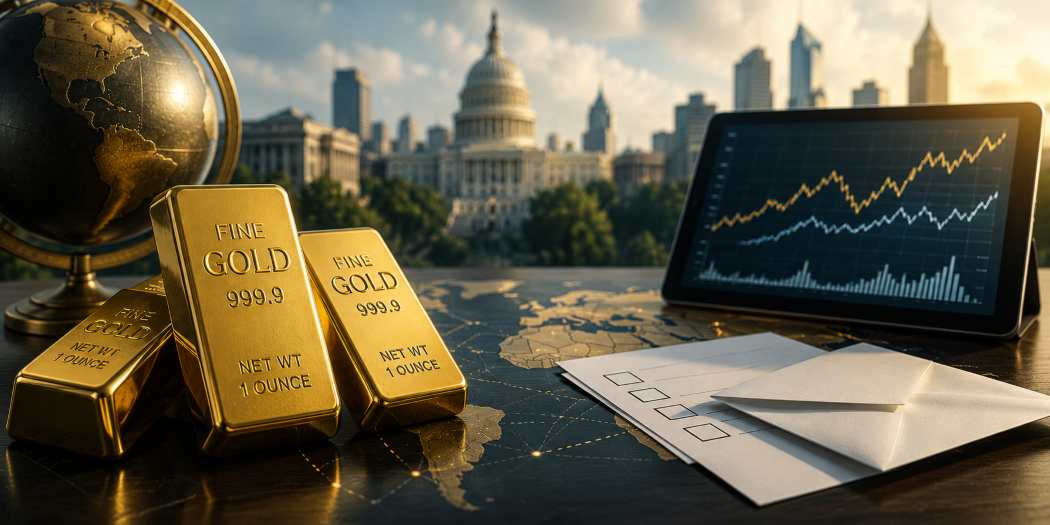
Why Election Years Often Put Precious Metals in the Spotlight
Election cycles have always attracted investor attention, but today's political landscape is unfolding against an unusually complex economic backdrop. Sticky inflation, elevated government debt, shifting trade policies, geopolitical conflicts, and expectations surrounding central bank interest-rate decisions have combined to make financial markets particularly sensitive to political developments. As countries representing a significant share of the global economy head to the polls, investors are paying closer attention to how election outcomes could influence monetary policy, fiscal spending, and broader market sentiment.
Gold has historically benefited during periods of heightened uncertainty, although not necessarily because of elections themselves. Markets rarely wait until ballots are counted before adjusting prices. Instead, investors continuously reassess the likelihood of policy changes that could affect inflation, currency values, economic growth, or geopolitical stability. Those expectations often begin influencing precious metals months before election day arrives.
Understanding that distinction is essential. Elections do not automatically drive gold prices higher, nor do they guarantee increased volatility. Rather, they create an environment in which financial markets rapidly evaluate changing probabilities, making gold one of several assets that investors monitor as uncertainty evolves.
Markets Often React Long Before the Results Are Final
Financial markets are forward-looking by nature. Investors rarely wait for certainty before repositioning portfolios, particularly when major elections have the potential to reshape fiscal policy, international trade, taxation, or government spending.
That explains why gold sometimes begins moving well before votes are cast. Polling data, campaign proposals, televised debates, and economic forecasts all contribute to shifting expectations about future policy. As confidence rises or falls, investors reassess risk across currencies, government bonds, equities, and precious metals.
Currency markets provide one of the clearest examples of this relationship. If investors expect election outcomes to weaken a country's fiscal position or place additional pressure on its currency, demand for traditional safe-haven assets may increase. Gold often benefits under those conditions because it is globally priced, highly liquid, and independent of any single government's monetary policy.
The opposite can also occur. Elections that reduce political uncertainty or reinforce confidence in economic policy may strengthen financial markets broadly, limiting safe-haven demand even if gold's longer-term fundamentals remain intact. The important point is that markets respond to changing expectations rather than election headlines alone.
This dynamic helps explain why gold's performance has varied across previous election cycles. Some elections coincided with powerful rallies, while others produced only modest price movements. The difference typically reflected the broader economic environment rather than the election itself.
Policy Expectations Usually Matter More Than Politics
Investors often focus on which candidate or political party wins an election, but financial markets are generally more interested in what policies are likely to follow. Elections can alter expectations for government spending, taxation, trade policy, regulation, and public borrowing—all of which influence inflation, interest rates, and currency valuations. Those factors have historically played a much larger role in precious metals pricing than the political outcome itself.
Fiscal policy is particularly important. Governments pursuing large spending programs or expanding budget deficits may contribute to higher borrowing requirements and, over time, increased inflation expectations. While the relationship is rarely immediate, sustained concerns about public debt and the purchasing power of fiat currencies have often supported long-term demand for gold as a store of value.
Central bank independence also becomes a market consideration during some election cycles. Investors closely monitor whether future governments may encourage looser monetary policy, pressure central banks to lower interest rates, or pursue policies that could weaken their domestic currency. Gold frequently attracts attention when confidence in monetary stability begins to erode because it carries no credit risk and is not tied to the policies of any single government.
Trade policy introduces another layer of uncertainty. Proposed tariffs, export restrictions, or shifts in international alliances can influence global supply chains, economic growth, and currency markets. Even before such policies take effect, investors often adjust portfolios based on how they expect businesses, consumers, and central banks to respond. In that environment, gold becomes part of a broader discussion about risk management rather than simply a reaction to political headlines.
Election Volatility Can Create Opportunity—But Timing Is Difficult
Election years often tempt investors to make short-term portfolio adjustments based on campaign developments or polling data. While political events can contribute to periods of heightened market volatility, history suggests that successfully trading around election results is far more difficult than many expect.
Markets frequently price anticipated policy changes well before election day, meaning much of the immediate reaction may already be reflected in asset prices by the time votes are counted. In some cases, the largest market moves occur after investors reassess how campaign promises are likely to translate into actual legislation rather than immediately following the election itself.
For long-term precious metals investors, elections are often best viewed as one component of a much broader market picture. Real interest rates, inflation expectations, central bank purchases, government debt levels, currency trends, and geopolitical developments have historically exerted a more persistent influence on gold prices than any single political event.
That perspective helps explain why many investors maintain strategic allocations to physical gold rather than attempting to trade every election cycle. Political uncertainty may increase demand periodically, but gold's long-term role as a portfolio diversifier extends well beyond any individual campaign or election calendar.
Gold Rarely Moves Alone During Election Cycles
Although gold receives most of the attention during politically uncertain periods, it is rarely the only precious metal responding to changes in market sentiment. Silver, platinum, and palladium each react differently because their prices are influenced by varying combinations of investment demand and industrial consumption.
Silver often occupies a unique position during election years. Like gold, it can benefit from safe-haven buying when uncertainty increases. At the same time, silver's extensive use in electronics, solar energy, and manufacturing means economic growth expectations also play a significant role in determining its price. If election outcomes are expected to stimulate industrial activity, silver may outperform gold even as both metals move higher.
Platinum and palladium tend to follow an even more industrial path. Demand from the automotive sector, chemical processing, and manufacturing often outweighs political uncertainty alone. Election-driven shifts in environmental regulations, emissions standards, or trade policies affecting vehicle production can therefore have a greater influence on platinum-group metals than traditional safe-haven demand.
Mining equities introduce another layer of complexity. Gold mining companies generally benefit when bullion prices rise, but their performance also depends on operating costs, production growth, energy prices, labor expenses, and management execution. As a result, mining stocks frequently experience greater volatility than physical bullion during election-driven market swings.
Viewing precious metals as a single asset class can therefore oversimplify the market. Each metal responds to a different balance of monetary, industrial, and geopolitical forces, making diversification within the sector just as important as diversification across broader investment portfolios.
FAQs
Do elections usually cause gold prices to rise?
Not necessarily. Elections themselves do not automatically push gold higher. Instead, markets react to uncertainty surrounding fiscal policy, inflation, interest rates, trade, and geopolitical developments. When investors expect greater economic or political risk, demand for safe-haven assets such as gold may increase. The broader economic backdrop often has a greater influence on gold prices than the election outcome alone.
Why does gold perform well during periods of political uncertainty?
Gold often benefits because it is viewed as a store of value during uncertain periods. Political events can create concerns about government spending, inflation, currency stability, or financial markets, encouraging investors to diversify into assets that are not tied to a single country's monetary system. However, gold's performance still depends on other macroeconomic factors beyond politics.
Do markets wait until election day to price political risk?
No. Financial markets are forward-looking and typically begin pricing expected policy changes months before an election takes place. Polling, economic data, campaign proposals, and geopolitical developments all influence investor expectations, meaning gold and other assets often respond well before ballots are cast or official results are announced.
How can government policy affect gold prices?
Government policies affecting spending, taxation, trade, and public debt can influence inflation expectations, interest rates, and currency values. Those economic factors often have a direct impact on investor demand for gold. Markets generally focus more on anticipated policy outcomes than on the political affiliation of election winners.
Does silver react to elections the same way as gold?
Not always. Silver shares some safe-haven characteristics with gold but also has significant industrial demand. As a result, silver prices often reflect both investor sentiment and expectations for manufacturing activity. Election outcomes that influence economic growth can therefore affect silver differently than gold.
Why do central banks matter during election years?
Central banks influence interest rates, inflation expectations, and currency values, all of which affect precious metals markets. During election years, investors often evaluate whether future governments may alter fiscal policy or place pressure on monetary authorities. Expectations surrounding central bank independence can influence demand for gold long before policy changes occur.
Should investors buy gold before an election?
There is no universal answer. While some investors increase precious metals exposure ahead of elections, markets frequently price expected outcomes well in advance. Long-term investors generally view gold as a portfolio diversifier rather than a short-term trade based solely on election calendars, focusing instead on broader economic and monetary trends.
Which precious metals are most affected by political uncertainty?
Gold is generally considered the primary safe-haven precious metal because it has a long history as a store of value during uncertain periods. Silver may also benefit from increased investment demand, while platinum and palladium tend to remain more closely tied to industrial activity and manufacturing conditions, even during election cycles.
Related reading you may find interesting:
Hyperinflation Explained: Causes, History & Protection
Why Central Banks Keep Buying Gold