
Why Two Old Silver Dollars Still Speak to Modern Collectors
The U.S. Mint's 2026 Morgan and Peace Dollar releases place two familiar designs side by side, but their shared denomination can disguise how differently they entered American life. This year's Enhanced Uncirculated coins, released August 25, carry the dual date 1776~2026 and a Liberty Bell privy marked 250, turning the pair into Semiquincentennial tributes. Yet the originals were never conceived as companions. They were products of different political arguments, economic pressures and national moods.
The Morgan Dollar emerged from a late-19th-century battle over silver, western mining and the nation's monetary system. The Peace Dollar arrived after World War I, when Americans were looking outward at a changed world and backward at the cost of the conflict. Their designs preserve that divide. One evokes an expanding industrial republic whose silver policy was entangled with mining and money; the other deliberately announces peace and a more modern national identity. For silver dollar collecting, comparing them means comparing two versions of America.
The Morgan Dollar Began With a Fight Over Silver
The Morgan Silver Dollar history starts before George T. Morgan's Liberty appeared on a coin. The Coinage Act of 1873 had ended production of the standard silver dollar, a decision that became deeply controversial as western silver output increased and debtors and silver interests pushed for remonetization. The Bland-Allison Act of 1878 reversed course. Passed over President Rutherford B. Hayes's veto, it required the Treasury to purchase substantial quantities of silver and coin them into dollars.
That legislation helps explain the Morgan Dollar's unusual character. It was legal tender, but its production was also an instrument of federal silver policy. The great western discoveries, including Nevada's Comstock Lode, had expanded the supply of American silver while mining states gained economic and political influence. Morgan Dollars were struck beginning in 1878 at Philadelphia, San Francisco and Carson City, with New Orleans joining production in 1879. Geography became part of the series, leaving collectors with mint-mark combinations tied to distinct chapters of American expansion.
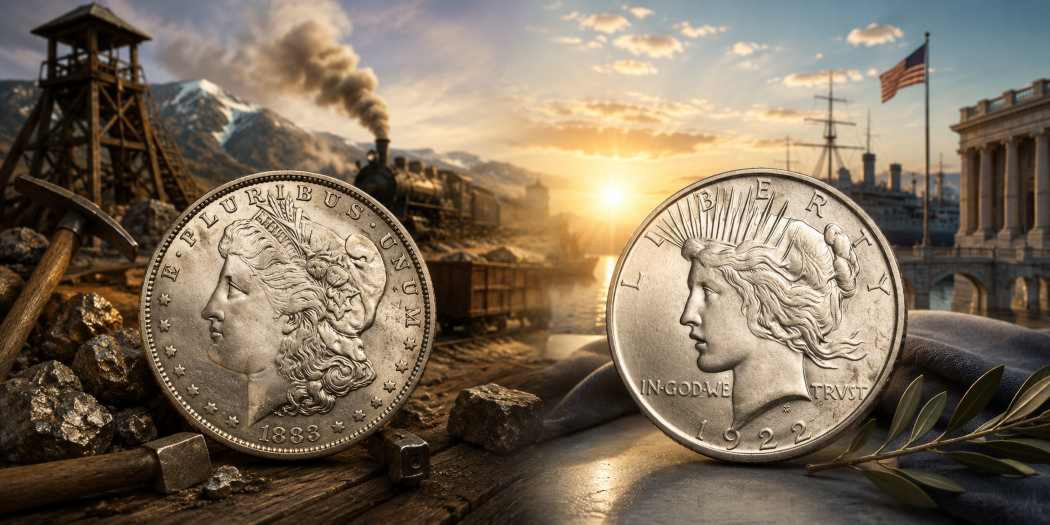
Morgan, an English-born engraver who later became Chief Engraver of the U.S. Mint, gave the new dollar a Liberty that departed from simply reproducing an older design. Her profile, surrounded by stars and E PLURIBUS UNUM, faces an eagle with outstretched wings on the reverse. Today the imagery feels inseparable from the American West, even though the coin's origin was rooted as much in congressional monetary policy as frontier mythology.
Millions of Morgans Spent Years Out of Sight
Despite heavy production, public demand for bulky silver dollars was limited, so many Morgans accumulated in Treasury vaults instead of circulating. That disconnect between coinage and commerce later helped preserve large numbers in remarkable condition.
Production stopped after 1904 when available bullion purchased under earlier legislation was exhausted. Then World War I unexpectedly rewrote the Morgan story. The Pittman Act of 1918 authorized the melting of hundreds of millions of silver dollars, much of the recovered silver ultimately supporting wartime and international monetary needs. The law also required replacement silver purchases, which brought Morgan Dollar production back in 1921 at Philadelphia, Denver and San Francisco.
That final Morgan year became a bridge rather than a true revival. The United States was no longer the country that had introduced the design in 1878. Industrial power had expanded dramatically, the First World War had altered America's international position, and artistic tastes had changed. Before 1921 ended, a new silver dollar was being struck in Philadelphia. Its purpose was not to celebrate silver production or satisfy the visual conventions of the previous century. Its very name declared what Americans were supposed to see in it.
The Peace Dollar Looked Toward a Different America
Peace Dollar history begins with the aftermath of war. Treasury Secretary Andrew Mellon approved Anthony de Francisci's design in December 1921 as a replacement for the Morgan Dollar, and the new coin commemorated the restoration of peace between the United States and Germany. The change in portrait also signaled a change in tone. America emerged from World War I with greater international influence and a desire for symbols that acknowledged sacrifice while looking toward renewal.
De Francisci's Liberty wears a radiant crown rather than Morgan's cap, flora and classical ornament. His wife, Teresa de Francisci, served as the model, giving the design a personal connection to the immigrant experience. On the reverse, an eagle rests with an olive branch above the word PEACE. The imagery is calmer than the Morgan reverse, yet the rays behind the eagle give it an unmistakable sense of dawn and forward movement.
The first 1921 Peace Dollars were struck in high relief, producing one of the series' most distinctive issues before the relief was lowered for practical production. Coinage continued through 1928, when the silver required under the Pittman Act had been exhausted and demand was weak. Production returned in 1934 and 1935 under new silver-purchase legislation.
Morgan vs Peace Dollar Collecting Reflects Their Different Pasts
Collectors encounter the two series differently because their histories created different kinds of challenges. Morgan Dollars offer a sprawling field of dates, mint marks, die varieties and famous condition rarities. Carson City issues bring the western mints directly into the collecting experience, while surviving Treasury-hoard coins created unusual situations in which some dates can be plentiful in Mint State despite having been struck more than a century ago.
Peace Dollars compress that pursuit into fewer years, but scarcity takes different forms. The 1921 high-relief issue marks the design's dramatic beginning, while certain later dates become difficult in better grades because strike quality and preservation vary. The Peace Dollar also belongs visually to the 20th century in a way the Morgan does not. Neither series is inherently more collectible: the Morgan offers depth, mint history and varieties, while the Peace Dollar offers a tighter set and unmistakable artistic identity. Collecting both makes the contrast more revealing.
The 2026 Coins Bring the Two Eras Back Together
The modern Morgan and Peace program turns what was once a replacement into a pairing. In 1921, the Peace Dollar ended the Morgan era. In 2026, the Mint presents the designs as parallel interpretations of the national story. Their dual date and Liberty Bell 250 privy connect designs born decades apart to the same anniversary.
That anniversary treatment works because the originals already function as historical markers. The Morgan Dollar reflects the politics of silver, western resource wealth, industrialization and a country expanding across the continent. The Peace Dollar reflects a nation altered by global war and increasingly conscious of its international position. One did not simply replace the other because engravers wanted a fresher design; the transition captured a deeper shift in what the United States had become.
For collectors deciding between Morgan vs Peace Dollars, the most interesting distinction is therefore not age, silver content or even rarity. It is perspective. Morgan's dollar looks back to an America still arguing over the monetary role of silver while building an industrial economy. De Francisci's looks toward a new era with the word PEACE beneath its eagle.
FAQs
What is the main difference between Morgan and Peace Dollars?
The biggest difference is the historical era each silver dollar represents. Morgan Dollars originated in 1878 amid political battles over silver, western mining and monetary policy, while Peace Dollars debuted in 1921 following World War I. Their designs reflect that transition as well. George T. Morgan used a more traditional 19th-century Liberty and heraldic eagle, while Anthony de Francisci created a modern Liberty and peaceful eagle imagery intended for a new American era.
Why did the U.S. Mint stop making Morgan Dollars?
Morgan Dollar production initially ended after 1904 because the silver bullion acquired under earlier purchase legislation had been exhausted. Production returned in 1921 because the Pittman Act required the government to purchase domestic silver to replace dollars previously melted under the law. Morgan Dollars were struck again at Philadelphia, Denver and San Francisco before the design gave way to the new Peace Dollar late that same year.
Why was the Peace Dollar created in 1921?
The Peace Dollar was introduced to commemorate the restoration of peace following World War I and to replace the aging Morgan Dollar design. Treasury Secretary Andrew Mellon approved Anthony de Francisci's design in December 1921. Its radiant Liberty and eagle holding an olive branch gave the dollar a distinctly different character from its predecessor, reflecting both remembrance of wartime sacrifice and America's emergence as a more influential international power.
Are Morgan Dollars rarer than Peace Dollars?
Morgan Dollars are not automatically rarer than Peace Dollars because rarity depends on the individual date, mint mark, variety and condition. Some Morgan issues survive in substantial numbers because quantities remained in government storage for decades, while others are scarce in particular grades. Peace Dollars have a shorter original series, but certain dates and high-grade examples can be challenging. Collectors should evaluate individual coins rather than assuming one entire series is scarcer than the other.
Why is the 1921 Peace Dollar different from later Peace Dollars?
The 1921 Peace Dollar is especially distinctive because it was originally produced in high relief. Anthony de Francisci's sculptural design gave the first issue a dramatic appearance, but the relief presented practical challenges for large-scale coin production. The Mint subsequently reduced the relief for later issues. As the first year of the series and a one-year high-relief design, the 1921 coin occupies a particularly important position within Peace Dollar collecting.
Did Morgan and Peace Dollars circulate at the same time?
Yes, Morgan and Peace Dollars could coexist in circulation because both were legal-tender silver dollars, although the transition between their production occurred in 1921. Morgan Dollar production resumed that year under requirements connected to the Pittman Act, and the Philadelphia Mint began striking Peace Dollars before the year ended. The overlap makes 1921 an unusually important dividing point in American numismatics: one classic silver-dollar design ended just as another began.
What is special about the 2026 Morgan and Peace Dollars?
The 2026 Morgan and Peace Dollars commemorate the 250th anniversary of American independence with special one-year design elements. The Enhanced Uncirculated versions were released August 25 and feature the dual date 1776~2026 along with a Liberty Bell privy containing the numeral 250. The modern releases deliberately reunite two designs that originally marked very different periods of U.S. history, giving collectors a contemporary connection to both classic silver-dollar series.
Related reading you may find interesting:
From Photography to Solar: How Industrial Silver Demand Changed