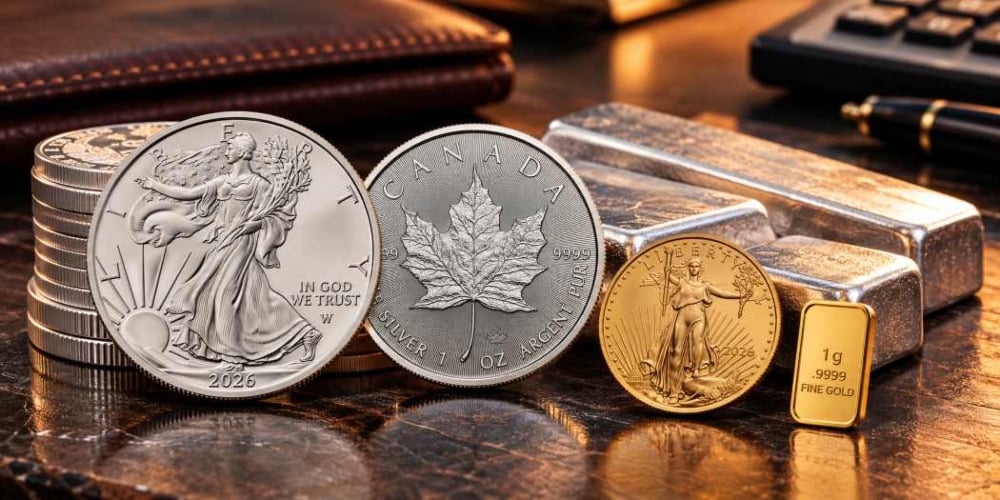





From a Single Gram to Institutional-Scale Gold
Walk through the gold-bar market and the range of sizes can seem surprisingly broad. A 1-gram bar can sit on a fingertip. A 1 oz bar contains 31.1035 grams of gold. A Kilo bar contains more than 32 troy ounces, while the large bars used in London's wholesale market typically weigh around 400 troy ounces.
Why isn't there simply one standard size?
Physical gold serves very different buyers. Someone making a relatively small purchase has different needs from an investor accumulating several ounces, just as both operate on a different scale from banks and professional vaults moving wholesale bullion. Refiners respond by producing gold in increments suited to different budgets, markets, storage arrangements, and resale needs.
That variety also creates a practical choice for buyers. The size of a bar can influence its premium over the gold spot price, how easily a holding can be divided, and how much gold must be sold in a single transaction. Choosing a bar is therefore about more than deciding how many ounces of gold to own.
Why Gold Bars Are Measured in Different Ways
Part of the variety comes from gold's international history. Precious metals are traditionally quoted in troy ounces in markets such as the United States and London, while metric weights are familiar throughout much of the world. Instead of one system replacing the other, the modern bullion market accommodates both.
One troy ounce equals approximately 31.1035 grams, while one kilogram equals about 32.1507 troy ounces, according to the LBMA's precious-metals market definitions. That is why a buyer may encounter bars marked 1 oz alongside products weighing 10 grams, 50 grams, 100 grams, or 1 kilogram.
The range creates useful steps between very small and very large purchases. Instead of having to choose between a fractional amount and a full ounce, buyers can select intermediate weights. Someone looking beyond 1 oz can likewise move into 50-gram, 100-gram, or Kilo formats without jumping directly to the enormous bars used in wholesale settlement.
The Hidden Economics Behind a Bar's Size
The gold inside a bar is only part of the finished product. Refiners also have to fabricate the bar, apply markings, perform quality control, and, for many retail products, provide individual packaging or assay materials. Handling, transportation, and distribution add further costs before the bar reaches a buyer.
Those expenses help explain one of the most noticeable differences between bar sizes: smaller bars generally carry higher percentage premiums. Producing ten individually finished and packaged 10-gram bars requires more separate processing and materials than producing a single 100-gram bar. The amount of gold may be similar, but the manufacturing economics are not.
Larger bars can spread those costs across more metal. That is one reason a Kilo gold bar may offer a lower cost per ounce than purchasing the same approximate quantity of gold through numerous fractional bars. Large cast bars may also use simpler packaging than small minted products, further reducing fabrication and presentation costs relative to the value of the gold.
Premium efficiency, however, is only one side of the decision. The very feature that makes a large bar efficient—putting more gold into one unit—also makes that holding less divisible.
Sometimes Paying More for Smaller Bars Has a Purpose
Suppose two investors own roughly the same total weight of gold. One holds it in a single large bar, while the other owns several smaller bars. Their metal exposure may be similar, but their options are different when it comes time to sell.
The owner of multiple bars can liquidate part of the holding and retain the rest. Selling one 10-gram bar does not require selling the other nine. With one 100-gram bar, by contrast, the entire unit normally changes hands in a single transaction. Smaller bars effectively divide a gold position into more manageable pieces.
That flexibility helps explain why buyers willingly pay higher premiums for fractional products. A small bar may also require less money for the initial purchase, allowing someone to acquire physical gold without committing to the cost of a full ounce. An ounce of gold can provide a middle ground: substantial enough to benefit from better manufacturing efficiency than very small bars while remaining far more accessible than a Kilo.
This does not mean the extra premium paid for a small bar will necessarily be recovered later. Resale values depend on the gold market, product recognition, dealer demand, condition, and other factors. Divisibility has practical value, but buyers should distinguish that benefit from an expectation that every dollar of retail premium will return at resale.
Why a 400 oz Bar Exists at All
Retail gold bars can look surprisingly small when placed beside the bullion used by financial institutions. The difference exists because wholesale markets solve an entirely different problem: moving very large amounts of gold efficiently.
Under the LBMA Good Delivery specifications, a qualifying London gold bar must contain between 350 and 430 fine troy ounces. These bars are commonly described as 400 oz bars, although their actual fine-gold content can vary within the permitted range. At current scales of institutional trading, moving one large bar is considerably more practical than handling hundreds of individually packaged 1 oz products.
A smaller bar made by the same refiner does not become a London Good Delivery bar simply because its manufacturer appears on the LBMA Good Delivery List. Kilo, 100 oz, and retail-sized products belong to different segments of the physical market and follow their own specifications.
Seen this way, the huge range of sizes is less unusual than it first appears. Wholesale bars facilitate institutional transactions and professional vaulting. Kilo and 100-gram products concentrate significant value into compact holdings. One-ounce bars provide a familiar retail unit, while fractional bars divide physical gold into progressively smaller amounts.
Bar Size Changes the Ownership Experience
Gold's high value relative to its physical size makes even larger retail bars remarkably compact. Consolidating a holding into fewer bars can simplify storage and reduce the number of individual pieces that must be inventoried. Buyers accumulating substantial amounts of metal may therefore prefer larger formats even apart from their potential premium advantage.
Yet concentration has consequences. If someone owns a Kilo bar and later wants to sell only a few ounces, the bar cannot simply be divided without destroying the original bullion product. The owner would generally need to sell the Kilo and, if desired, purchase a smaller quantity afterward. Someone who accumulated individual 1 oz bars could instead sell only the number required.
Liquidity therefore involves more than asking whether gold itself has an active market. The denomination of a physical holding affects how precisely an owner can adjust that position. Widely recognized sizes may also be familiar to a broader pool of dealers and buyers, although actual bids can still vary with refinery, product, inventory, and market conditions.
For many buyers, this is why a mixture of sizes can be more useful than pursuing the lowest available premium on every purchase. Larger bars can provide efficient exposure, while smaller units preserve options.
There Is No Universal Best Size
The many sizes found in the gold bar market are not unnecessary variations of the same product. They reflect the different jobs physical gold is expected to perform.
A buyer prioritizing a smaller initial purchase or greater divisibility may accept the higher percentage premium of fractional bars. Someone building a larger position may prefer 1 oz, 100-gram, or Kilo bars because more gold is concentrated into each unit and fabrication costs can become more efficient. Institutions operate on another scale entirely, where very large standardized bars make moving and vaulting substantial quantities of metal practical.
The better question, then, is not simply which gold bar costs the least per ounce. It is how much gold the buyer wants in each individual unit. Once premiums, storage, purchase size, and eventual resale are considered together, the reason gold comes in so many sizes becomes clear: one bar cannot efficiently serve every kind of gold owner.
FAQs
What are the most common gold bar sizes?
Common retail sizes include 1 gram, 5 grams, 10 grams, 20 grams, 1 troy ounce, 50 grams, 100 grams, and 1 kilogram. Exact offerings vary by refinery and market. One-ounce bars are widely recognized in the U.S., while gram-denominated bars provide additional increments for buyers who prefer metric weights or want to purchase amounts smaller or larger than a single troy ounce.
How many grams are in a 1 oz gold bar?
A 1 troy ounce gold bar contains approximately 31.1035 grams of gold. Precious metals use the troy-ounce system rather than the ordinary avoirdupois ounce commonly encountered in the United States. An avoirdupois ounce weighs approximately 28.35 grams, so it should not be used when converting the stated weight of ounce-denominated investment gold.
How many ounces are in a Kilo gold bar?
One kilogram equals approximately 32.1507 troy ounces. A Kilo bar therefore concentrates more than 32 one-ounce equivalents of gold into a single unit. This can provide efficient storage and potentially lower premiums per ounce, but it also means that selling the bar generally requires liquidating a much larger amount of gold at once.
Why do small gold bars usually have higher premiums?
Small bars generally carry higher percentage premiums because fabrication, quality control, packaging, handling, and distribution costs are spread across less gold. Producing numerous individually finished and packaged fractional bars can require more resources than producing one larger bar containing a similar total weight. The higher premium effectively accompanies the accessibility and divisibility offered by the smaller format.
Is a 1 oz gold bar better than a 100-gram bar?
Neither is universally better. A 1 oz bar requires less capital and lets an owner sell a smaller amount of gold at one time. A 100-gram bar contains more than three troy ounces and may provide greater premium efficiency. The better fit depends on the buyer's budget, desired divisibility, storage preferences, available premiums, and eventual resale plans.
Are 400 oz gold bars exactly 400 ounces?
No. “400 oz” is a convenient description for the large bars commonly used in London's wholesale gold market. Under LBMA Good Delivery specifications, a qualifying gold bar must contain between 350 and 430 fine troy ounces. These institutional bars serve a very different purpose from precisely sized retail products such as 1 oz, 100-gram, and Kilo bars.
Does a larger gold bar always have a lower premium?
Not necessarily. Larger bars often have lower percentage premiums because manufacturing and distribution costs are spread across more gold, but size is not the only factor. Refinery, product availability, dealer inventory, market demand, and broader bullion conditions can affect premiums. Buyers should compare actual products rather than assuming the heavier bar will always provide the lowest cost per ounce.
Should I buy one large gold bar or several smaller bars?
That depends largely on the balance between cost efficiency and flexibility. One large bar may consolidate a holding and reduce the premium paid per ounce, while several smaller bars allow the owner to sell part of the position without liquidating all of it. Some buyers combine different sizes to gain some of the advantages of both approaches.