



A $50 Gold Coin Can Contain Thousands of Dollars in Gold
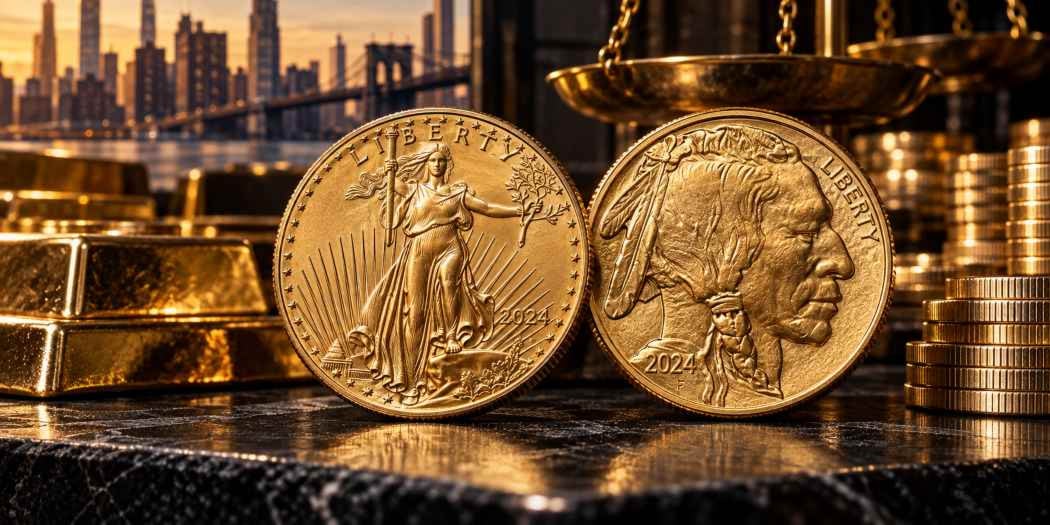
A one-ounce American Gold Eagle carries a face value of $50. So does a one-ounce American Gold Buffalo. Yet either coin contains one full troy ounce of gold, making its metal value vastly greater than the denomination stamped on it. The same basic disconnect appears across many modern sovereign bullion programs.
That apparent contradiction becomes easier to understand once face value and bullion value are separated. The denomination establishes the coin as government-issued money within its legal framework. It was never designed to track the changing market price of the precious metal inside the coin.
For modern bullion coins, those two values perform completely different jobs. Gold determines what the metal is worth. The denomination identifies the piece as a coin.
Face Value Is a Monetary Denomination, Not a Gold Price
When a government mint places a denomination on a bullion coin, it gives that coin a monetary identity. The U.S. Mint introduced the American Gold Buffalo in 2006 as a $50 legal-tender coin containing one ounce of .9999 fine, 24-karat gold.
The American Gold Eagle demonstrates the distinction even more clearly because the program uses different denominations for different gold weights. The one-ounce coin carries $50 in face value, the half-ounce coin $25, the quarter-ounce coin $10 and the tenth-ounce coin $5. Those denominations create an orderly monetary structure across the series, but none is intended as a statement of the gold’s current market value.
A buyer examining a one-ounce Gold Eagle therefore encounters several values simultaneously. There is the $50 denomination on the coin. There is the market value of its one troy ounce of fine gold. There is also the actual retail price, which normally incorporates the metal value plus the costs and premium associated with producing, distributing and selling a finished bullion product.
That is why comparing the denomination with the retail price can be misleading. They answer different questions.
Why Not Make the Face Value Equal to the Gold Value?
Gold prices move continuously. A fixed denomination does not.
If a mint attempted to make the face value of a bullion coin approximate its gold value, the denomination could become obsolete almost immediately. A one-ounce coin issued when gold traded at one level could contain substantially more—or less—metal value years later without anything about the coin itself changing.
A floating denomination would create the opposite problem. Currency denominations are intended to be clearly identifiable monetary units, not numbers that must be repeatedly altered to follow commodity markets. Modern bullion programs avoid that conflict by assigning a fixed nominal value while allowing the underlying metal to trade at its market price.
The relationship can persist for decades. The U.S. Mint launched the American Eagle Coin Program in 1986, and the one-ounce Gold Eagle still carries a $50 denomination. The American Buffalo arrived in 2006 as the first .9999 fine, 24-karat gold coin produced by the U.S. government for investors and collectors, also with a $50 face value.
Gold has moved dramatically since either program began. The denomination did not need to follow it because that was never the denomination’s purpose.
Legal Tender Does Not Mean Bullion Coins Are Meant for Checkout Lines
The words “legal tender” can create another misconception. If a Gold Eagle is legally a $50 coin, could someone theoretically treat it as fifty dollars?
Its denomination does not disappear simply because its gold is worth far more. But using a one-ounce Gold Eagle at its nominal value would surrender the much greater economic value represented by the metal. In normal bullion markets, buyers and dealers therefore evaluate the coin according to gold content, product demand and applicable premiums rather than its denomination.
This distinction also helps explain the difference between sovereign bullion coins and privately produced bullion. A government-issued gold coin can carry an official denomination because it is issued under a national monetary authority. A private gold round may contain the same quantity and purity of gold without having any official face value.
The denomination therefore tells a buyer something important about what the object is, even when it tells very little about what the object is worth.
Gold Content Is Only the Starting Point
Once face value is set aside, the way bullion markets price a gold coin becomes easier to understand.
Consider a standard one-ounce American Gold Eagle. It contains one full troy ounce of fine gold, although its 22-karat composition gives the complete coin a greater total weight because silver and copper are added to the alloy. The U.S. Mint lists the one-ounce coin at 33.931 grams overall while specifying one troy ounce of contained gold. Its composition is 91.67% gold, 3% silver and the balance copper.
That ounce establishes the coin’s basic connection to the gold market, but buyers rarely acquire finished bullion coins for exactly the value of their metal. Minting, wholesale distribution, dealer inventory and market demand all contribute to the premium. The premium can also change independently of gold itself. A highly sought-after bullion coin may become more expensive relative to spot even if the underlying metal price barely moves.
This is one reason the choice between gold bars and gold coins involves more than comparing how much gold each contains. Government minting, recognizability, liquidity and secondary-market demand can influence what buyers are willing to pay.
Older coins can move even further away from a simple bullion calculation. A scarce date, exceptional condition or historically important issue may attract collector demand that substantially exceeds the value of its gold. NYC Bullion's guide to classic pre-1933 U.S. gold coins examines how rarity, grade, historical significance and surviving populations can add numismatic value beyond the underlying metal.
The important point is not that every gold coin carries a large premium. It is that a single coin can contain several sources of value at once, and only one of them is printed on its surface.
How Should You Actually Value a Gold Coin?
Instead of starting with the denomination, begin with the coin’s specifications. Identify its actual fine-gold content, then compare that quantity with the current gold price. That provides a bullion reference point.
Next comes the product itself. A widely recognized sovereign coin may trade at a different premium from a privately minted round or bar containing the same amount of gold. Availability matters too. Premiums can expand when demand for a particular coin rises faster than dealer inventories and contract when supply becomes more plentiful. The ABPMEX guide to bullion premiums examines how product type, mint recognition, liquidity and investor demand can affect these differences.
Only after those bullion considerations should numismatic factors enter the calculation. Most current bullion coins are primarily valued for their precious-metal content and market premium. Older, scarce or unusually well-preserved coins may require a completely different approach in which date, mintmark, grade and collector demand become increasingly important.
This framework explains why two objects containing the same amount of gold do not necessarily command the same price. A government-issued gold coin can combine recognizable specifications, sovereign issuance and a legal denomination, while a privately produced round provides precious-metal ownership without being government-issued currency.
The face value is therefore best understood as part of a gold coin’s identity rather than a shortcut to its worth. A $50 Gold Eagle remains a $50-denomination U.S. coin whether gold rises or falls, while the market continually reprices the ounce of gold inside it.
For a buyer, that separation is useful. The denomination answers one question: what kind of monetary object is this? Gold content, premiums and—when applicable—collectability answer the much more practical question: what is this particular coin worth today?
FAQs
Why does a one-ounce Gold Eagle have only a $50 face value?
The $50 denomination identifies the one-ounce American Gold Eagle as an official U.S. coin; it is not intended to represent the market value of its gold. The coin contains one full troy ounce of fine gold, so its bullion value follows the gold market instead. The denomination remains fixed while gold prices fluctuate, allowing the coin to retain a stable monetary identity without requiring its face value to change whenever gold moves.
Is an American Gold Eagle really legal tender?
Yes. American Gold Eagles are U.S. coins with congressionally established denominations. The one-ounce version has a $50 denomination, while fractional versions carry $25, $10 and $5 denominations. That status does not mean bullion owners normally spend the coins at face value. Because their contained gold is worth substantially more than their denominations, Gold Eagles are generally bought, sold and valued as precious-metal coins rather than used for ordinary transactions.
What determines the actual value of a gold bullion coin?
The market value of a gold bullion coin begins with the quantity of fine gold it contains and the prevailing gold price. A retail premium may then reflect minting, distribution, inventory, recognizability, liquidity and product demand. Certain coins can also develop numismatic premiums based on scarcity, condition or collector interest. Face value generally plays little role in normal bullion pricing because it is a fixed monetary denomination rather than a measure of current metal value.
Why do gold coins have face values but gold bars do not?
Government-issued coins can carry denominations because they are produced under a sovereign monetary authority, while conventional gold bars are bullion products rather than currency. A denomination establishes a coin's official monetary identity within the issuing country's coinage system. Private rounds generally work like bars in this respect: although they may resemble coins and contain investment-grade precious metal, they are not sovereign currency and normally carry weight and purity markings instead of official denominations.
What is the face value of a one-ounce Gold Buffalo?
A one-ounce American Gold Buffalo has a face value of $50. The U.S. Mint introduced it in 2006 as a legal-tender coin containing one ounce of .9999 fine, 24-karat gold. Its actual bullion value is based primarily on the gold it contains rather than its $50 denomination, with market premiums potentially adding further value.
Could gold ever fall below a bullion coin’s face value?
In principle, a bullion coin's denomination establishes a nominal monetary value, but modern gold bullion denominations are deliberately far below the metal values at which the coins normally trade. Gold would therefore have to undergo an extraordinary decline before the face value of a one-ounce Gold Eagle or Gold Buffalo approached its contained metal value. Their low denominations maintain a substantial separation between fixed monetary face value and fluctuating bullion value.
Does a higher face value make one gold coin more valuable?
Not necessarily. Comparing denominations across different countries can be especially misleading because currencies and bullion programs are structured differently. Market value depends much more heavily on the quantity of gold contained in the coin, prevailing metal prices, product premiums, condition and collector demand. Face value primarily identifies the coin's denomination within the issuing country's monetary system rather than establishing the price at which bullion buyers should value it.
Are old gold coins valued the same way as modern bullion coins?
Not always. Modern bullion coins are generally priced around their gold content plus a product premium. Older gold coins may also derive substantial value from rarity, grade, mintmark, historical significance, surviving population and collector demand. A common historic coin might remain relatively close to its metal value, while a scarce or exceptionally preserved example can command a much larger numismatic premium.