
The Gold Story Beneath Manhattan
New York has never been a major gold-mining region. Yet few American cities have a deeper connection to the metal. For nearly two centuries, gold arriving from elsewhere has been weighed, refined, stored, traded and priced through institutions clustered within a remarkably small part of Lower Manhattan.
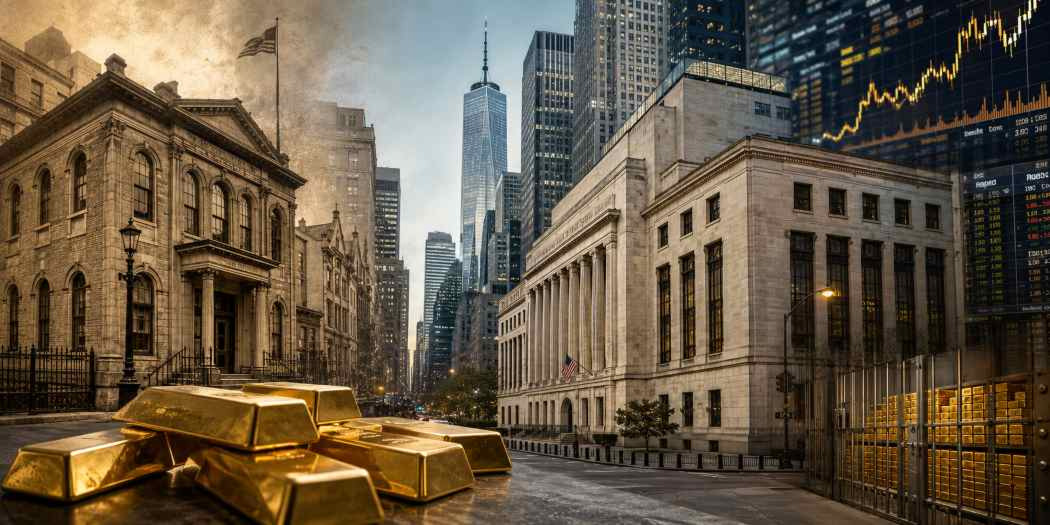
That distinction helps explain the New York gold market today. The city's importance did not arise from proximity to mines; it grew from proximity to money. As New York became the country's banking and securities capital, the infrastructure surrounding gold followed. The U.S. Assay Office gave bullion a federal gateway on Wall Street. The Federal Reserve Bank of New York later made Manhattan an international center for official gold custody. Futures trading eventually added another role: price discovery.
The result is an unusual history in which the physical metal gradually became less visible above ground even as New York's influence over the American bullion market increased.
Wall Street Needed Gold Before It Had an Assay Office
Gold was already intertwined with New York finance long before the federal government established a permanent bullion facility there. Banks, merchants and brokers operated in an economy where specie mattered, foreign coins circulated and the ability to convert financial claims into precious metal carried practical significance.
The California Gold Rush changed the scale of the problem. Enormous quantities of newly mined metal were moving into the American economy, while New York was becoming increasingly important to the nation's commercial and financial system. Sending bullion elsewhere for federal processing added time and friction precisely where merchants and financial institutions wanted liquidity.
Congress responded in 1853 by authorizing a United States Assay Office in New York. It opened the following year at 30–32 Wall Street, in a building that had previously housed the Second Bank of the United States. The location was revealing: rather than putting the facility near a mine, the government put it near the institutions that dealt with money.
The New York Assay Office could receive gold and silver bullion, determine its fineness and process precious metal within the federal monetary system. Manhattan now had an official bridge between raw bullion and America's financial center.
The Assay Office Made Wall Street a Physical Gold Hub
The Assay Office endured long after many similar facilities disappeared. Western assay offices often followed mining booms and declined as regional production changed. New York's survived because its usefulness rested on commerce rather than extraction.
Its operations evolved considerably over nearly 130 years, but the longevity itself tells the story. The U.S. Mint records the New York facility as operating from 1854 until 1982, making it a striking exception among federal assay offices. Melting operations ended in 1981, followed by the facility's closure the next year.
By then, New York no longer needed an assay office to secure its place in the gold business. A different institution only blocks away had already given the city a role extending far beyond domestic bullion.
The creation of the Federal Reserve System in 1913 made New York's financial position impossible to ignore. When the regional Reserve Banks were organized, policymakers debated how powerful the New York institution should become. Although proposals for an overwhelmingly dominant New York Fed were rejected, it still opened in 1914 as the largest Reserve Bank in the system.
Gold soon became part of its international function.
How the New York Fed Became a Global Gold Custodian
The New York Fed received its first foreign central-bank gold deposit in 1916, while World War I made transporting bullion across the Atlantic particularly hazardous. Holding metal in New York allowed official institutions to maintain reserves in a secure financial center and settle certain transactions without repeatedly shipping heavy bars across oceans.
That role became physically embedded in Manhattan when the Fed constructed its headquarters at 33 Liberty Street. Engineers excavated to Manhattan bedrock to support the extraordinary weight of the vault and its contents. When the building opened in 1924, its lowest vault level sat roughly 80 feet below street level.
Gold holdings expanded dramatically through the disruptions of the twentieth century. Countries sent reserves to the United States during and after World War II, reinforcing New York's reputation as a financial safe harbor. Holdings ultimately peaked at more than 12,000 metric tons in 1973, shortly after the United States ended dollar convertibility into gold for foreign governments.
The vault remains the world's largest known depository of monetary gold. As of 2024, the New York Fed reported approximately 507,000 bars weighing 6,331 metric tons. A crucial distinction is often overlooked: that gold does not belong to the Federal Reserve. The New York Fed acts as custodian for account holders that include governments, central banks and official international institutions.
That makes New York important to gold for a reason quite different from Fort Knox. One represents U.S. government reserves; the other became infrastructure for the international monetary system.
COMEX Gave New York a New Role in Gold
Physical custody explains only part of New York's modern importance. Another transformation came when gold became an actively traded futures product.
Americans had faced extensive restrictions on private monetary gold ownership beginning in the 1930s. After those restrictions were removed at the end of 1974, gold futures trading began in New York almost immediately. CME Group records December 31, 1974 as the first trading date for COMEX gold futures.
This changed the meaning of gold trading in New York. Standardized futures allowed traders to hedge exposure and express expectations about future gold prices without requiring an immediate physical movement of bullion. COMEX eventually became part of CME Group, while electronic trading transformed a market once associated with New York trading floors into a nearly continuous global marketplace.
Geography became less visible, but the market's New York roots remained. COMEX is now one component of an interconnected international gold market that also includes London wholesale trading, physical bullion transactions and electronic platforms. Its importance comes from price discovery: buyers, sellers, hedgers and speculators continuously translate changing expectations about interest rates, currencies, inflation and risk into tradable gold prices.
From Wall Street Vaults to Today's Bullion Prices
New York's gold history is ultimately a story of changing functions. The Assay Office disappeared in 1982. Most futures activity no longer depends on a physical trading floor. Gold beneath Liberty Street generally remains out of sight, and individual investors cannot store their bullion there. None of those changes diminished the city's association with the metal.
Instead, New York's influence shifted toward the financial infrastructure surrounding gold. Banks, commodity traders, investment firms, futures markets and the New York Fed connect the metal with currencies, Treasury markets, interest rates and global capital flows. That network helps explain why a gold investor today may watch the dollar, bond yields and COMEX futures alongside the spot price.
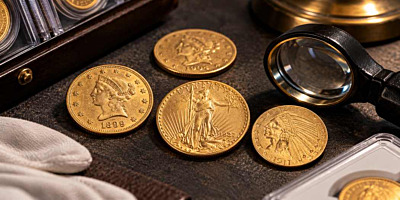
For individual bullion buyers, the connection is practical. A coin purchased from a New York bullion dealer may have been minted thousands of miles away from metal mined on another continent. Its price nevertheless reflects a global market in which New York remains an important center of trading and financial risk management.
That is the thread running from the nineteenth-century Assay Office to today's electronic markets. New York first became useful because bullion could be authenticated and processed close to American finance. The Federal Reserve era made the city a custodian of international monetary gold; COMEX added futures and price discovery.
Manhattan never needed to produce gold to become central to its American story. New York's lasting contribution was building institutions that connected physical gold to the financial system—and repeatedly adapting those institutions as the meaning of the gold market changed.
FAQs
When did the New York Assay Office open?
The U.S. Assay Office in New York opened in 1854 after Congress authorized it the previous year. Located at 30–32 Wall Street, it processed gold and silver bullion close to the nation's growing financial center. The facility remained in operation until 1982, long after many other assay offices had closed.
Why was New York important to the gold market?
New York became important because it was already a major center for banking, commerce and securities. The city did not need nearby gold mines; it needed institutions capable of processing, storing and trading bullion. The Assay Office, New York Fed and COMEX each added a different layer to that role.
How much gold is stored at the New York Fed?
As of 2024, the Federal Reserve Bank of New York reported roughly 507,000 gold bars weighing 6,331 metric tons in its vault. The gold is held for eligible account holders such as governments, central banks and international institutions. It does not belong to the Federal Reserve itself.
Can individuals store gold at the New York Fed?
No. The New York Fed's gold vault is not available to private investors or commercial customers. It serves eligible official institutions, including governments and central banks. Individual investors who want physical gold storage must use private vaults, depositories or other commercial storage services.
When did COMEX begin trading gold futures?
COMEX gold futures began trading on December 31, 1974, shortly after restrictions on private gold ownership in the United States were removed. Futures trading gave investors and institutions a standardized way to hedge gold exposure and trade expectations about future prices.
Does COMEX set the gold price?
COMEX is an important source of gold price discovery, but it does not set the global gold price by itself. Gold trades across interconnected futures, wholesale and physical markets worldwide. COMEX matters because heavy trading activity continuously reflects changing expectations about interest rates, currencies, inflation, investment demand and risk.
Related reading you may find interesting:
How Much Gold Should You Buy at One Time?