



A Tiny Number That Raises a Big Question
Browse enough gold bullion listings and one detail quickly begins to stand out. Some products are described as .999 fine gold, while others proudly display .9999 fine gold, often accompanied by phrases like 'four-nines fine' or 'ultra-high purity.' It's a small difference on paper, but one that leads many first-time buyers to the same conclusion: if one coin is purer, it must also be the better investment.
The reality is more nuanced.
Purity certainly matters, and every reputable bullion product clearly states its fineness. Yet the extra nine is often given far more weight than it deserves. Investors sometimes assume it translates into meaningfully higher value, stronger long-term performance or greater market acceptance, when in practice the differences are far more subtle. In the global bullion market, both .999 and .9999 gold comfortably qualify as investment-grade precious metal, and both are bought and sold every day by dealers, refiners and investors around the world.
Understanding what those numbers actually measure—and where they do and do not matter—helps place gold purity in its proper context alongside other considerations such as liquidity, recognizability and overall product quality.
Measuring Purity in Practical Terms
The numbers stamped on a gold bar or bullion coin refer to its fineness, a standard that expresses how much of the finished product is pure gold. A fineness of .999 means the metal is 99.9 percent pure, while .9999 indicates 99.99 percent purity. The remaining fraction consists of minute residual elements left after refining, measured in mere hundredths or thousandths of a percent.
On paper, the distinction appears meaningful. In the hand, it is almost impossible to perceive.
A one-troy-ounce bullion product contains approximately 31.1035 grams of metal. A .999 fine piece contains about 31.072 grams of pure gold, while a .9999 fine piece contains roughly 31.100 grams. The difference is only 0.028 gram—less than the weight of a single grain of rice and far below what most buyers could ever detect without laboratory equipment.
That comparison doesn't diminish the achievement of producing four-nines fine gold. Instead, it illustrates why experienced bullion investors rarely judge a product solely by the extra decimal place. The overwhelming majority of its value still comes from the one troy ounce of gold it contains.
Why Four-Nines Gold Became the Industry Benchmark
The rise of .9999 gold had as much to do with advancing technology as it did with marketing.
By the late twentieth century, improvements in refining allowed several sovereign mints to produce exceptionally pure bullion on a commercial scale. Rather than simply matching existing industry standards, they saw an opportunity to distinguish their products by emphasizing metallurgical precision alongside trusted government backing.
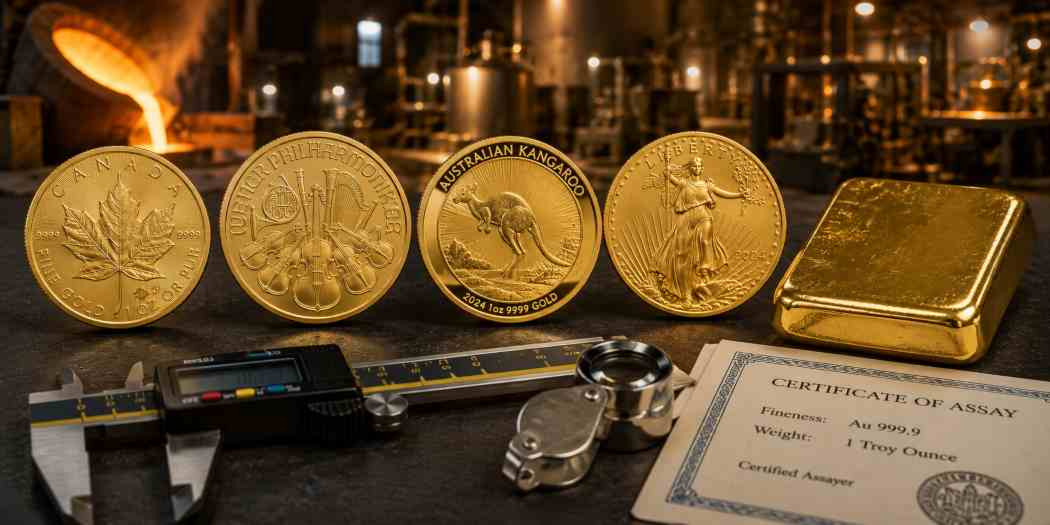
The Royal Canadian Mint was one of the pioneers. After introducing the Gold Maple Leaf in 1979 as a .999 fine bullion coin, it soon increased the purity to .9999, establishing a standard that became closely associated with the series. Other leading mints followed, including Australia's Perth Mint with its Gold Kangaroo program and the Austrian Mint with the Gold Philharmonic, both of which continue to produce four-nines fine bullion today.
For these institutions, .9999 purity became part of a broader reputation for refining excellence rather than a claim that competing bullion products were somehow inadequate. High-purity gold reflected technical capability, but it also gave investors another point of confidence in an increasingly competitive global bullion market.
At the same time, .999 gold never disappeared. Numerous respected private refiners continue producing .999 fine investment bars that trade freely across international markets, demonstrating that recognition, quality control and market acceptance often carry just as much weight as the final decimal place.
The American Gold Eagle Is the Exception That Proves the Rule
Conversations about gold purity often lead to an understandable misconception: if .9999 is the highest standard, does that make every other bullion coin less desirable?
The American Gold Eagle answers that question immediately.
Unlike most modern bullion coins, the Gold Eagle is struck from 22-karat gold, or .9167 fine. At first glance, that appears to place it well below coins such as the Maple Leaf or Philharmonic. In reality, every one-ounce Gold Eagle still contains one full troy ounce of pure gold. The difference is that the coin also includes small amounts of silver and copper, increasing its total weight while improving resistance to scratches, dents and everyday handling.
That alloy was a deliberate design choice rather than a limitation in refining technology. It follows a long tradition of durable circulating gold coinage, giving the American Gold Eagle a slightly warmer color and greater resilience without reducing its actual gold content.
For investors, this is one of the clearest reminders that purity alone does not determine value. The market prices a one-ounce Gold Eagle alongside other one-ounce bullion coins because buyers are purchasing one troy ounce of gold, regardless of the alloy surrounding it.
Does Four-Nines Gold Command a Premium?
Walk through the inventory of any major bullion dealer and you'll notice that .9999 gold products sometimes carry higher premiums than comparable .999 bullion bars. It's tempting to assume the additional cost reflects the extra purity, but that is rarely the primary reason.
Premiums are shaped by a much broader combination of factors. Refining costs, production volumes, mint reputation, global recognition and retail demand all influence the final selling price. A Gold Maple Leaf may trade above a generic .999 bar not simply because it contains slightly purer gold, but because it is issued by a sovereign mint, incorporates advanced security features and enjoys exceptional liquidity in markets around the world.
The reverse can also be true. A widely recognized .999 fine bar from a respected international refiner may command a stronger premium than a lesser-known .9999 product if buyers place greater confidence in its brand and resale potential.
That illustrates an important point for investors: premiums are ultimately determined by the market, not by a single decimal place.
What Experienced Buyers Usually Compare Instead
After spending time in the bullion market, many investors stop asking whether a coin is .999 or .9999 and begin asking different questions altogether.
How easily can it be sold? Is it recognized internationally? Does it come from a respected sovereign mint or a well-established private refinery? Does it incorporate modern anti-counterfeiting technology? How competitive is the premium compared with similar products?
Those considerations often have a more immediate effect on ownership than the minute difference between 99.9 and 99.99 percent purity.
This helps explain why products as different as the Canadian Gold Maple Leaf, American Gold Eagle, Austrian Gold Philharmonic and Perth Mint Gold Kangaroo all maintain loyal followings. Each appeals to investors for its own combination of reputation, craftsmanship, liquidity and global acceptance rather than because one contains a fraction of a gram more pure gold than another.
A Difference Worth Understanding—Not Overestimating
The distinction between .999 and .9999 gold is real, but its significance is often misunderstood.
Four-nines purity reflects remarkable advances in modern refining and has become an important hallmark for several of the world's leading bullion programs. It demonstrates technical excellence and gives investors confidence that they are purchasing exceptionally pure precious metal.
At the same time, investment decisions should rarely hinge on that distinction alone. Both .999 and .9999 bullion products are internationally recognized, widely traded and valued primarily for the gold they contain. Even the American Gold Eagle—struck in a durable 22-karat alloy—contains a full troy ounce of pure gold despite its lower stated fineness.
For most buyers, the stronger considerations are authenticity, liquidity, trusted minting standards and competitive pricing. Once those fundamentals are in place, the extra nine becomes what it has always been: an impressive achievement in refining, but only one piece of a much larger investment picture.
FAQs
What is the difference between .999 and .9999 gold?
The difference lies in the metal's fineness. Gold marked .999 is 99.9% pure, while .9999 gold is 99.99% pure. Although .9999 contains slightly less residual material after refining, the actual difference in pure gold content is extremely small. In a one-ounce bullion product, it amounts to only about 0.028 gram, making both standards internationally recognized as investment-grade fine gold.
Is .9999 gold worth more than .999 gold?
Not automatically. The market values bullion primarily according to its actual gold content, weight, brand recognition and liquidity rather than the extra level of purity alone. While some .9999 bullion coins carry higher premiums, those premiums usually reflect the issuing mint's reputation, security features, production costs and demand instead of simply the additional decimal place.
Why do some sovereign mints produce .9999 gold?
Many sovereign mints adopted .9999 purity as refining technology advanced and commercial production became more efficient. The Royal Canadian Mint helped popularize four-nines fine bullion with the Gold Maple Leaf, followed by producers such as the Perth Mint and Austrian Mint. Higher purity became a way to showcase refining expertise while offering investors exceptionally pure government-backed bullion.
Is .999 gold still considered investment-grade?
Yes. Bullion refined to .999 purity fully meets international standards for investment-grade precious metals and is widely accepted by dealers, refiners and investors around the world. Numerous respected private refiners continue producing .999 fine gold bars, and these products trade alongside .9999 bullion without difficulty in global precious metals markets.
Why is the American Gold Eagle only .9167 fine?
The American Gold Eagle uses a 22-karat alloy containing gold, silver and copper to improve durability. Although its stated purity is .9167, every one-ounce Gold Eagle still contains a full troy ounce of pure gold. The additional metals increase the coin's overall weight and make it more resistant to scratches and wear without reducing its actual gold content.
Does higher purity make gold easier to sell?
Generally, no. Both .999 and .9999 bullion products enjoy strong global recognition and excellent liquidity. Dealers typically focus on authenticity, weight, condition and the reputation of the issuing mint or refinery. Well-known products from respected manufacturers often sell just as readily regardless of whether they are .999 or .9999 fine.
Which bullion coins are made from .9999 gold?
Many of the world's leading sovereign bullion coins are struck from .9999 fine gold. Popular examples include the Canadian Gold Maple Leaf, Australian Gold Kangaroo and Austrian Gold Philharmonic. These programs have helped establish four-nines purity as a hallmark of premium government-issued bullion, although other respected investment coins use different compositions.
Should investors choose .9999 gold over .999 gold?
For most investors, the difference in purity is less important than buying authentic bullion from a trusted source. Factors such as dealer reputation, liquidity, recognizable brands, competitive premiums and secure storage generally have a greater influence on long-term ownership than the slight difference between 99.9% and 99.99% purity.
Does .9999 gold scratch more easily?
Because .9999 gold contains fewer alloying metals, it is slightly softer than lower-purity gold products. In practice, however, most modern bullion coins and bars are stored in protective packaging or capsules, so this difference rarely affects investors. Durability becomes more relevant for coins intended to be handled frequently, such as the 22-karat American Gold Eagle.