

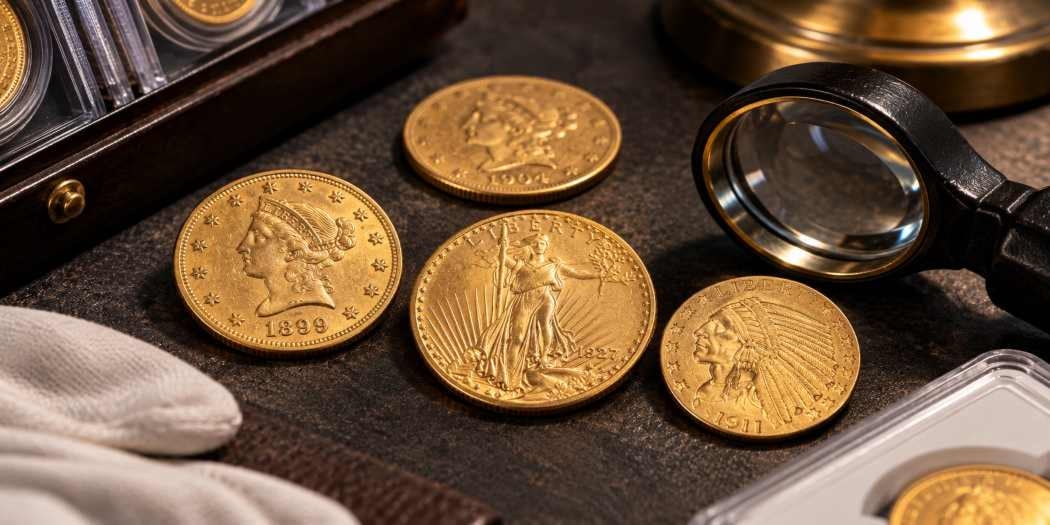
Gold Content Is Only the Starting Point
A gold coin can have two different sources of value. The first is straightforward: the amount of precious metal it contains. The second is numismatic value, which reflects what collectors may pay for characteristics such as rarity, condition, date, mintmark, historical significance, or a desirable variety. For some coins, the metal accounts for nearly all of the market price. For others, collector demand can push the value well beyond the gold itself.
Age alone does not tell you which type you have. A common 19th-century gold coin may trade relatively close to its intrinsic value, while another coin of similar age and appearance could command a substantial premium. Identifying the difference requires a methodical look at the coin rather than an assumption that old automatically means rare.
For owners who inherit or discover gold coins, the safest approach is to identify the piece before cleaning it, selling it, or relying on an online asking price. A few basic details can quickly indicate whether deeper numismatic research is warranted.
Start With the Date, Mintmark, and Exact Coin Type
Begin by determining the denomination, issuing country, date, and design. With classic U.S. gold, for example, identifying a coin simply as an “old $20 gold piece” is not enough. Liberty Head and Saint-Gaudens Double Eagles belong to different series, and individual dates within those series can have very different collector markets.
Next, look for a mintmark. Historic U.S. gold coins were struck at facilities including Philadelphia, Charlotte, Dahlonega, New Orleans, Carson City, Denver, and San Francisco. A mintmark can transform an otherwise ordinary-looking coin into a much scarcer issue. Conversely, the absence of one is not necessarily unusual because Philadelphia coins from many periods were produced without mintmarks.
Resources such as PCGS CoinFacts can help confirm designs, dates, mintmarks, specifications, and known varieties. Once the exact issue is established, meaningful comparisons become possible. Without that identification, price estimates can be misleading because visually similar gold coins may occupy very different parts of the collector market.
Rarity Is More Complicated Than the Original Mintage
Mintage figures are useful, but they should not be mistaken for the number of coins that still exist. Gold coins have been melted, exported, lost, damaged, and removed from circulation for generations. As a result, an issue with a seemingly substantial original mintage can be difficult to find today, while another with a smaller mintage may have survived at a comparatively high rate.
Collector demand matters alongside survival. A genuinely scarce coin does not automatically command an enormous premium if relatively few people collect the series, while a more available key date in a popular series may face intense competition whenever an attractive example reaches the market.
Professional grading-service population reports can provide additional context by showing how many examples have been certified at particular grades. Those figures are useful indicators rather than perfect census counts, since coins can be resubmitted and many surviving pieces remain uncertified.
This combination of original production, estimated survival, condition rarity, and collector demand is what makes numismatic scarcity different from simply reading a mintage number.
Condition Can Change the Value Dramatically
After identifying the coin, examine its state of preservation. Numismatic grading considers wear, luster, surface marks, strike quality, and other characteristics, typically using the 70-point Sheldon scale. The NGC grading scale provides a useful overview of how circulated and Mint State coins are classified.
The important point is that condition must be considered within the specific issue. A certain grade might be common for one date but unusually difficult to find for another. In that case, collectors may pay a significant premium for the better-preserved coin even though its gold content is unchanged.
Owners should also resist the temptation to clean an old coin. Polishing, wiping, dipping, or otherwise altering original surfaces can reduce numismatic appeal and may result in a grading service identifying the piece as cleaned or damaged. A coin that looks dull is not necessarily in poor numismatic condition, and making it brighter can do more harm than good.
If a coin appears potentially scarce or unusually well preserved, professional evaluation is safer than attempting to improve its appearance.
Use Comparable Sales, Not Just Asking Prices
Once the date, mintmark, and approximate condition are known, recent sales can help establish whether the coin has a meaningful collector premium. Completed auction results are generally more informative than online listings because an asking price only shows what a seller hopes to receive.
Comparisons need to be specific. Ideally, examine sales of the same date, mintmark, variety, and similar grade. An exceptional Mint State example cannot provide a realistic valuation for a heavily circulated coin simply because the date matches. Certification can also influence comparability because buyers may place greater confidence in coins authenticated and graded by established third-party services.
The underlying gold value provides a useful baseline. Historical U.S. gold denominations contain different amounts of actual gold, so the face value or physical size of a coin should not be used to assume its bullion value. Comparing its actual gold weight with the current gold price helps establish how much of the market price comes from metal and how much may represent collector demand.
If comparable transactions repeatedly occur well above intrinsic value, the coin may have an established numismatic premium. One unusually high auction result, however, should not be treated as proof of what every example is worth.
When Does Professional Certification Make Sense?
Third-party grading can be worthwhile when authenticity, condition, or variety has a meaningful effect on a coin's potential value. PCGS and NGC authenticate submitted coins, assign grades when appropriate, and encapsulate them in holders that make subsequent market comparisons easier.
Certification is not automatically necessary for every gold coin. Submission fees, shipping, and insurance can make grading uneconomical for a common circulated issue that trades mainly for its metal content. A potentially scarce date, high-grade example, unusual variety, or coin whose authenticity is uncertain presents a stronger case for professional review.
This is one reason an initial evaluation by an experienced numismatist can be useful. It may help determine whether certification is justified before the owner incurs those costs. NYC Bullion's broader guide to bullion and numismatic coins also explains why coins purchased primarily for precious metal exposure should be evaluated differently from pieces whose market is driven partly by collectors.
The distinction becomes particularly important when selling. A common gold coin may be appropriately valued largely according to its precious metal content, while a scarce certified issue deserves comparison with the numismatic market before an offer is accepted.
Look at the Whole Coin Before Deciding What It Is Worth
Determining whether a gold coin has numismatic value is less about finding one magic indicator than assembling several pieces of evidence. The date and mintmark establish the issue; surviving population and collector demand provide context for scarcity; condition determines where the individual coin sits within that population; and comparable sales show what buyers have actually been willing to pay.
The process also helps prevent two opposite mistakes. Owners may underestimate a collectible coin by treating it only as gold, or overestimate a common piece because it is old, attractive, or listed online at an ambitious price. Neither approach reflects how the numismatic market works.
Before selling an unfamiliar gold coin, identify it carefully, leave its surfaces untouched, and compare it with genuinely similar examples. When the evidence points toward scarcity, unusual condition, or a substantial premium above intrinsic value, professional numismatic evaluation may be worthwhile. Ultimately, a coin's collector value comes not from age alone, but from the particular combination of rarity, condition, demand, and historical identity that collectors are willing to pay for.
FAQs
Does an old gold coin automatically have numismatic value?
No. Age can contribute to collector interest, but an old gold coin may still be common enough to trade primarily for its precious metal content. Date, mintmark, surviving population, condition, and collector demand all need to be considered before assuming that age creates a substantial premium.
How can I tell if my gold coin is rare?
Start by identifying its exact type, date, denomination, and mintmark. Then research original mintages, estimated surviving populations, grading-service population reports, and comparable sales. A low mintage can be a useful clue, but it does not establish rarity by itself.
Does cleaning a gold coin reduce its value?
It can. Cleaning may leave hairlines, altered surfaces, or other evidence that reduces collector appeal. If a gold coin could have numismatic value, avoid polishing or cleaning it before obtaining an evaluation.
Is a graded gold coin always worth more?
No. Certification can provide authentication and an independent opinion of condition, but grading does not make a common coin rare. Whether certification adds practical market value depends on the coin, its grade, demand, and the costs involved.
How do I know if a gold coin is worth more than its gold content?
Determine the coin's actual gold content and compare its intrinsic value with recent sales of the same date, mintmark, variety, and similar grade. Consistent sales substantially above metal value can indicate an established numismatic premium.
Should I have an inherited gold coin professionally evaluated?
Professional evaluation can be worthwhile when the coin is unfamiliar, appears scarce, is unusually well preserved, or could carry a significant premium above its gold content. Identification should come before cleaning, grading, or selling.