

When the Dollar Was Defined by Gold
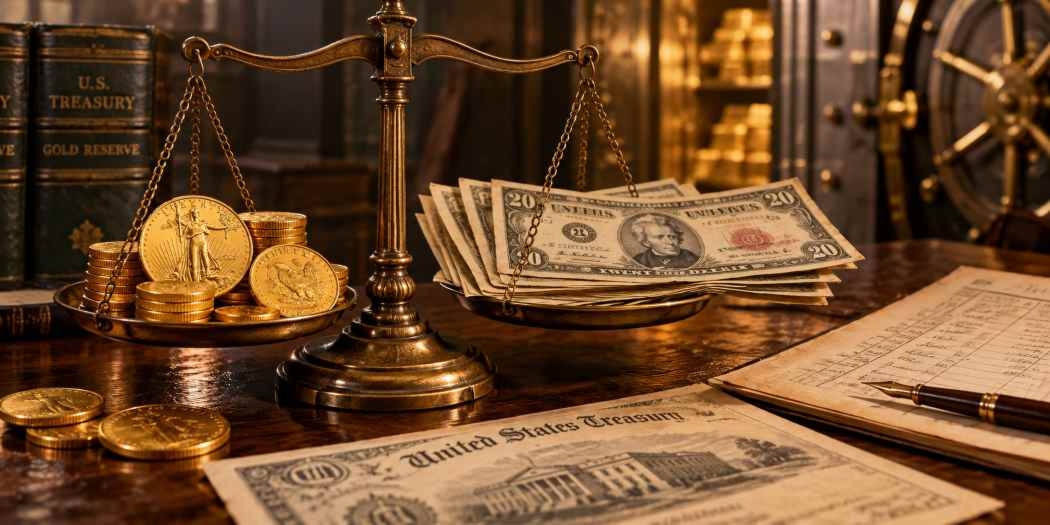
The phrase gold standard is familiar, but the system itself is often misunderstood. It did not mean that every paper dollar had an individual gold coin sitting in a government vault, nor did Americans conduct every purchase with physical gold. Paper currency, bank deposits, silver coins, and gold coins could all circulate within the economy. What mattered was the monetary promise behind them: the dollar was legally defined in relation to a specific quantity of gold, and the government maintained convertibility at that official rate.
That promise made gold part of the monetary mechanism rather than simply an asset owned by the government. After the Civil War-era suspension of specie payments, the United States resumed gold convertibility in 1879. The Gold Standard Act of 1900 subsequently established gold as the country's standard of value and defined the dollar using 25.8 grains of gold nine-tenths fine. In practical terms, this corresponded to approximately $20.67 for one troy ounce of fine gold.
Unlike today's gold spot price, that dollar-gold relationship was not established by continuous market trading. It was part of the definition of the currency itself. Maintaining that relationship required the government to hold gold reserves and remain prepared to meet legitimate demands for redemption.
How Dollar-to-Gold Convertibility Worked
Under a functioning gold standard, eligible currency could ultimately be exchanged for gold according to the legally established rate. Gold could also enter the monetary system in exchange for currency. This two-way convertibility helped keep the dollar close to its official gold value because a substantial departure from that relationship would create an incentive to exchange one form of money for the other.
The Treasury therefore needed sufficient reserves to preserve confidence in redemption. The Gold Standard Act established a dedicated gold reserve and mechanisms for replenishing it if redemptions reduced the government's holdings. Gold reserves were not simply symbolic assets sitting behind the currency; their availability helped determine whether the government could credibly maintain the dollar's fixed value.
This also explains why the historical system was more complicated than saying each dollar was backed by an equivalent dollar's worth of gold. The monetary system contained far more than physical coins and Treasury gold. Bank deposits, notes, credit, and other claims circulated throughout the economy. The critical commitment was that the monetary authorities would defend convertibility at the established rate.
The Federal Reserve's history of U.S. monetary policy describes the gold standard as a framework in which the central bank commits to exchanging domestic currency for a fixed quantity of gold. That commitment placed a constraint on monetary policy that does not exist in the same form under today's fiat-dollar system.
Why Gold Flows Could Affect the Entire Economy
Gold convertibility mattered not only to people exchanging currency domestically but also to international finance. Countries operating under gold-based systems effectively linked their currencies through fixed relationships with the metal. Trade imbalances and movements of investment capital could therefore produce actual gold flows between nations. If the United States experienced sustained outflows, its reserves could decline and confidence in convertibility could come under pressure.
Those pressures could influence interest rates, lending, and the supply of money. Authorities attempting to stop gold from leaving could favor tighter monetary conditions, while gold inflows could provide greater room for monetary and credit expansion. During the Panic of 1893, for example, falling Treasury gold reserves contributed to fears about the government's ability to maintain redemption, intensifying an already serious financial crisis.
This mechanism illustrates both the discipline and the weakness associated with the gold standard. A government could not expand money and credit indefinitely without considering whether doing so threatened its gold commitment. Supporters viewed that limitation as protection against excessive monetary expansion. At the same time, defending convertibility could require policies that were poorly suited to domestic economic conditions, particularly during banking crises or recessions.
Nor did the gold standard guarantee permanently stable prices. When economic output grew faster than the monetary gold supply, deflationary pressure could develop. Large gold discoveries or increases in production could work in the opposite direction. Monetary conditions were therefore partly influenced by changes in the supply and movement of a metal whose production did not necessarily correspond to what the broader economy needed.
Why the American Gold Standard Ended in Stages
The Great Depression exposed that conflict on an extraordinary scale. Banks were failing, economic activity had contracted severely, and demand for gold placed additional pressure on the financial system. Policies designed to defend convertibility could interfere with attempts to expand money and credit. In 1933 and 1934, the Roosevelt administration fundamentally changed the relationship between Americans, the dollar, and monetary gold.
The Gold Reserve Act of 1934 transferred monetary gold to the U.S. Treasury and ended the previous domestic convertibility structure. The official valuation of gold was subsequently changed from approximately $20.67 to $35 per ounce. For ordinary Americans, the classical system in which dollars could function as claims on monetary gold had effectively ended decades before 1971.
Gold nevertheless retained an important international role after World War II. Under the Bretton Woods system, participating currencies were linked to the dollar, while the United States maintained an official gold relationship of $35 per ounce for foreign monetary authorities. The dollar became the principal reserve currency, but gold remained the ultimate international anchor behind the arrangement.
Over time, foreign dollar holdings expanded far beyond the U.S. gold stock available to satisfy potential conversions at the official rate. That imbalance increasingly undermined the system. On August 15, 1971, President Richard Nixon suspended the dollar's remaining convertibility into gold. Bretton Woods subsequently unraveled, and major currencies moved toward the floating exchange-rate system familiar today.
This is why saying the United States simply abandoned the gold standard in 1971 leaves out an important part of the story. Domestic convertibility had already been dismantled in the 1930s. What ended in 1971 was the remaining international dollar-to-gold link.
What the Gold Standard Means for Gold Investors Today
The modern dollar works very differently. It is fiat currency and cannot be redeemed with the U.S. government for a legally fixed quantity of gold. The Federal Reserve can alter monetary conditions without maintaining dollar-to-gold convertibility, while gold trades independently according to global supply, demand, interest rates, currency movements, central-bank activity, investment flows, and other market forces.
That difference also changes the role of physical bullion. During the historical gold-standard era, gold helped define the monetary unit itself. Today's physical gold bullion and gold coins are independently priced assets rather than pieces of a dollar-conversion mechanism. Buying gold today therefore does not recreate the old gold standard or turn modern dollars into gold-backed currency.
Understanding the historical system nevertheless helps explain gold's continuing monetary significance. For much of modern financial history, gold was not merely a commodity whose price happened to rise or fall against the dollar. It was part of the framework used to define money, settle international obligations, and constrain monetary policy. The system disappeared because those constraints became increasingly difficult to reconcile with modern economic management, but gold's long monetary history remains one reason the metal continues to occupy a distinctive position in global finance.
FAQs
What was the U.S. gold standard?
The U.S. gold standard was a monetary framework in which the dollar was legally defined as a fixed quantity of gold and monetary authorities maintained convertibility at that relationship. Gold therefore served as an anchor for the currency rather than simply an investment or government reserve asset. Paper money and bank deposits could still circulate extensively even though gold stood behind the system's central monetary commitment.
Was every U.S. dollar backed by its own gold?
No. The system did not require one specific piece of gold to be stored for every dollar in circulation. What mattered was the government's commitment to maintain the official dollar-gold relationship and honor eligible redemption demands. Because bank deposits, currency, credit, and other monetary claims circulated simultaneously, the connection between total money in the economy and the government's physical gold reserves was more complicated than one-to-one backing.
What was gold worth under the U.S. gold standard?
Following the Gold Standard Act of 1900, the dollar's legal gold definition corresponded to approximately $20.67 per troy ounce of fine gold. This was fundamentally different from today's market-determined gold price because the relationship helped define the currency itself. During the Roosevelt administration's restructuring of the monetary system, the official gold valuation was later changed to $35 per ounce.
Why did gold flows matter under the gold standard?
Gold could move between countries in response to trade balances, capital movements, and redemption demand. Significant outflows reduced a country's monetary reserves and could threaten confidence in its ability to maintain the official conversion rate. Policymakers might respond with tighter monetary conditions or higher interest rates, meaning international gold movements could eventually affect domestic credit, banking conditions, economic growth, and prices.
Did Americans use physical gold coins under the gold standard?
Yes. Gold coins circulated during important periods of the U.S. gold-standard era alongside paper currency, bank deposits, silver coins, and other forms of money. The system did not require consumers to conduct everyday transactions exclusively in gold. Its defining feature was instead the fixed relationship between the dollar and gold and the ability, under the applicable monetary rules, to convert eligible currency into the metal.
Did the U.S. gold standard end in 1933 or 1971?
Both dates describe different stages. The changes of 1933 and 1934 effectively ended the traditional domestic convertibility system for Americans. Gold later remained at the center of the international Bretton Woods system, under which foreign monetary authorities retained a dollar-to-gold relationship. President Nixon suspended that remaining international convertibility in 1971, ending the dollar's final formal link to gold.
Is the U.S. dollar backed by gold today?
No. The U.S. dollar is fiat currency and is not redeemable for a fixed quantity of gold. Gold now trades independently in global markets, while the Federal Reserve conducts monetary policy without maintaining gold convertibility. Physical gold can still serve as an investment, reserve asset, or store of value, but owning dollars no longer represents a legal claim on a predetermined amount of government-held gold.