

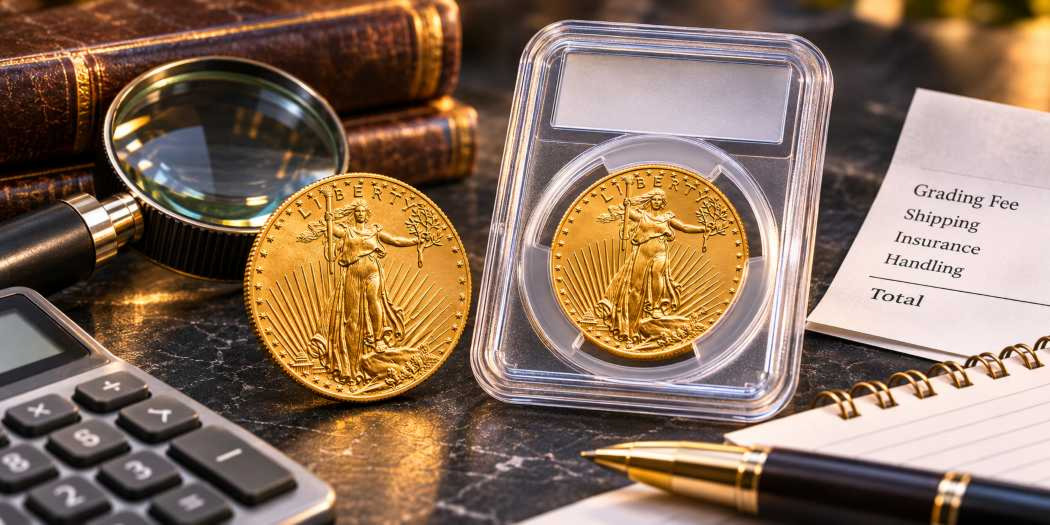
When Does Gold Coin Grading Pay for Itself?
A gold coin might be worth $2,000 uncertified and $2,150 in a professional grading holder. That $150 difference initially makes certification attractive. However, if grading, insured shipping, and handling cost $110, the potential gain falls to $40. A lower-than-expected grade could eliminate that benefit entirely.
This is the calculation owners should make before submitting coins to PCGS or NGC. Professional certification can establish authenticity, document condition, and improve marketability, but its financial benefits vary considerably. Ordinary bullion coins often trade primarily on gold content, while pre-1933 U.S. gold and scarce dates may command substantial premiums for particular grades. The question is whether certification adds enough realistic resale value to justify its complete cost.
What Does Professional Gold Coin Grading Really Cost?
The advertised grading fee represents only part of the expense. Membership requirements, processing charges, insured shipping, and optional services can increase the total, while the appropriate submission tier depends on the coin's declared value. Comparing grading companies solely by their headline fees can therefore be misleading.
As of November 2026, PCGS lists a $42 Regular service fee for eligible member submissions with declared values up to $3,000. Its nonmember Direct Plus option costs $115 per coin, with a $2,500 maximum declared value. The less expensive nonmember Direct tier excludes gold coins. Meanwhile, NGC's 2026 fee update establishes a $45 Gold grading tier for eligible coins valued up to $5,000. Different membership arrangements and eligibility rules mean these prices are not directly interchangeable.
Consider a hypothetical single-coin submission:
|
Expense |
Illustrative cost |
|
Grading service |
$45 |
|
Insured outbound shipping |
$25 |
|
Return shipping and insurance |
$30 |
|
Processing or handling |
$10 |
|
Total |
$110 |
Illustrative costs, not an official grading-service quotation. Membership and optional fees are excluded.
Submitting several coins together can distribute fixed shipping expenses across more pieces, reducing the average cost per coin. Nevertheless, each piece still incurs a grading charge, and higher declared values may require more expensive services. For an owner submitting one coin, the complete $110 expense matters more than the advertised $45 grading fee.
The Break-Even Calculation: Will Certification Add Value?
Certification makes financial sense when the additional resale proceeds exceed the total submission expense. Retail asking prices are not reliable evidence of that benefit because a dealer's actual purchase offer may be considerably lower. Completed sales and realistic dealer quotations provide a stronger basis for comparison.
Suppose an uncertified gold coin could sell for $2,000 today. After certification, a dealer offers $2,180. Subtracting $110 in expenses leaves a potential $70 gain. However, the outcome depends on the assigned grade, and even a small difference can change the calculation:
|
Outcome |
Raw resale offer |
Certified resale offer |
Grading cost |
Net difference |
|
Favorable grade |
$2,000 |
$2,250 |
$110 |
+$140 |
|
Expected grade |
$2,000 |
$2,100 |
$110 |
−$10 |
|
Lower grade |
$2,000 |
$2,020 |
$110 |
−$90 |
Certified resale proceeds − raw resale proceeds − grading expenses = net benefit or loss.
The difference between adjacent grades can be significant for collectible coins, making accurate identification essential. Owners should research completed sales for the same date, mint mark, variety, and likely condition rather than relying on unusually high listings. NYC Bullion's guide to identifying numismatic value in gold coins explains how rarity and collector demand influence prices beyond precious-metal content.
Why Bullion and Collectible Gold Need Different Calculations
American Gold Eagles, Gold Buffalos, Maple Leafs, and other common bullion coins generally derive most of their value from gold content and prevailing premiums. Reputable dealers routinely authenticate these products without third-party grading, so certification may contribute little additional resale value. For example, if an MS69 Gold Eagle receives a $25 premium over an equivalent raw coin but costs $110 to grade, the owner faces an $85 shortfall.
Special releases, proofs, and exceptional MS70 examples may attract stronger collector interest, although those premiums cannot be assumed for every submission. Buyers can compare certified and uncertified offerings through NYC Bullion's gold coin selection. For ordinary bullion, certification may be worthwhile for personal collecting preferences, but the financial justification is often limited.
Pre-1933 U.S. gold coins, scarce dates, and recognized varieties present a different situation. Their values can depend heavily on authenticity, preservation, and collector demand. A historical gold coin worth $3,000 uncertified might justify grading if comparable certified examples consistently achieve substantially higher resale prices. However, the owner must account for higher submission tiers and the possibility of receiving a lower grade or details designation due to cleaning, damage, or altered surfaces.
Authentication can also improve marketability when a coin's mint mark or surfaces raise questions. For valuable collectibles, PCGS's grading and authenticity guarantee outlines protections associated with qualifying certified coins. These protections have limitations and do not guarantee future resale prices, but they may provide reassurance to buyers evaluating expensive numismatic pieces.
Should You Grade a Gold Coin Before Selling It in NYC?
The intended resale market should influence the decision. Certification may help an expensive collectible attract auction bidders or specialized buyers who rely on standardized grades. For common bullion, a local dealer can usually evaluate the coin without an additional submission, making grading unnecessary for many straightforward transactions.
Before submitting, obtain a realistic raw-coin valuation and compare it with offers for similarly graded examples. New York City sellers can consult bullion dealers and numismatic specialists to determine whether the potential premium justifies the expense. My Gold Hunter's article on what makes a gold coin easier to resell examines how recognition and buyer demand influence resale opportunities alongside condition.
Submission time also matters. A coin awaiting certification cannot be sold immediately, while gold prices and collector demand may change before its return. An experienced numismatist can provide a preliminary grade assessment, helping owners identify submissions with a reasonable chance of recovering their costs. Although that opinion cannot guarantee the final grade, it can prevent unnecessary expenses when the potential benefit is limited.
Grade the Coin Only When the Numbers Support It
Professional grading is not an automatic increase in value. For common bullion, submission costs frequently exceed the additional resale premium, while rare or condition-sensitive collectibles may benefit substantially from authentication and a recognized grade. The distinction depends on the specific coin, its likely condition, and the buyers interested in acquiring it.
Before submitting, compare the coin's current raw resale value, its realistic certified value, and the complete grading expense. A narrow potential gain leaves little room for an unfavorable grade or additional charges. Coins should also remain untouched during evaluation, since cleaning or polishing can permanently damage their surfaces and reduce numismatic value.
Ultimately, certification is worthwhile when its practical benefits and potential additional proceeds justify the money, time, and uncertainty involved. A carefully researched cost comparison provides a stronger basis for that decision than assuming every graded gold coin is automatically more valuable.
FAQs
How much does it cost to grade a gold coin?
The total depends on the grading service, declared value, submission tier, and shipping arrangements. PCGS and NGC charge per-coin fees, but owners may also pay for membership, processing, insured shipping, and optional services. A grading fee of $45 could result in a total expense exceeding $100 for a single coin. Always calculate the complete submission cost using the service's current fee schedule before sending a valuable gold coin.
Is grading a common American Gold Eagle worth it?
Usually, grading a common bullion American Gold Eagle is difficult to justify purely on resale economics. Dealers routinely trade authentic raw Eagles, and many certified examples command only modest additional premiums. If grading costs $110 but increases the resale offer by $25, the owner incurs an $85 net disadvantage. Special releases, proofs, and exceptional grades can behave differently, so compare equivalent raw and certified examples before deciding.
Is PCGS or NGC cheaper for grading gold coins?
Neither service is universally cheaper. PCGS and NGC have different membership requirements, grading tiers, declared-value limits, handling charges, and shipping arrangements. One service may offer a lower base fee while another produces a lower total for a particular submission. Comparing only advertised grading prices can therefore be misleading. Request or calculate the complete cost for the specific coin, including shipping and insurance, before choosing a provider.
Does a professionally graded gold coin always sell for more?
No. Certification may improve confidence in authenticity and condition, but it does not automatically create a collectible premium. Common bullion coins can sell for similar amounts whether raw or certified, while rare coins may command substantial differences between grades. Even when a certified coin sells for more, the additional proceeds may not cover submission expenses. The relevant measure is the net difference after all grading and selling costs.
Should I grade an inherited pre-1933 gold coin?
An inherited pre-1933 gold coin may warrant professional evaluation, particularly if its date, mint mark, or condition suggests collector value. However, not every historical gold coin is rare, and some trade primarily according to their gold content. Identify the exact issue and research comparable sales before submitting it. A knowledgeable numismatist can help assess whether the likely certification benefit exceeds grading, insurance, and shipping expenses.
Can a gold coin receive a lower grade than expected?
Yes. Professional graders assess surface preservation, wear, strike, and other characteristics, and their final opinion may differ from an owner's expectations. A coin can also receive a details designation if cleaning, damage, or other surface problems prevent a standard numerical grade. The grading service generally charges for the examination regardless of the result. This uncertainty should be included when estimating the potential financial benefit of certification.
Is it better to grade a gold coin before selling it?
That depends on the coin and the intended buyer. Certification may help market a rare or expensive collectible, particularly when buyers want independent authentication and a standardized grade. For ordinary bullion, dealers can often authenticate the coin without third-party grading, making submission unnecessary. Obtain a raw-coin offer, estimate the certified resale value, and subtract the full grading cost before deciding whether certification is worthwhile.