



Silver’s Industrial Story Has Been Rewritten
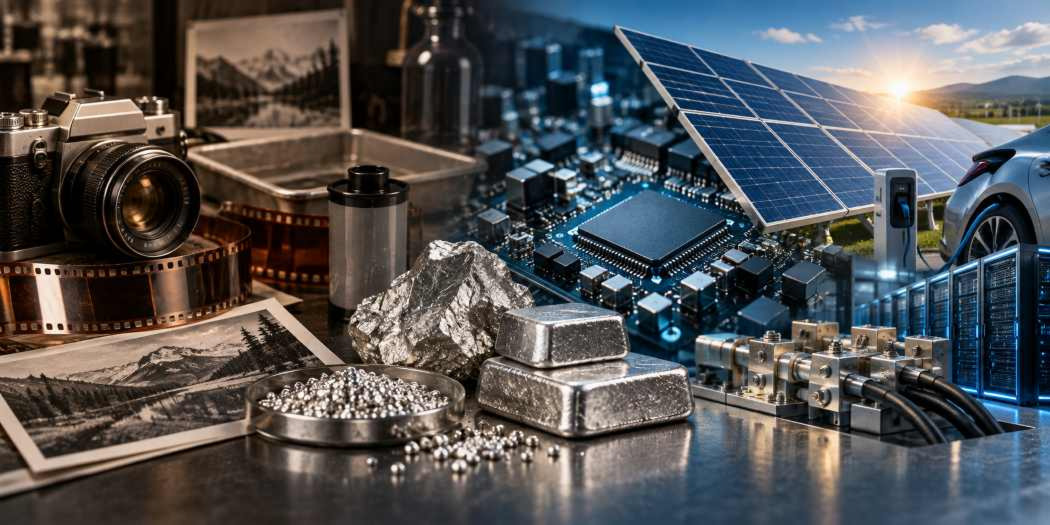
For much of the twentieth century, one of silver’s most important industrial destinations was a strip of film. Its light-sensitive chemistry made the metal indispensable to cameras, medical X-rays and commercial imaging, tying a meaningful share of demand to how the world recorded pictures. That relationship weakened rapidly after digital photography arrived. Silver did not lose its industrial relevance, however. Demand migrated into circuitry, vehicles, power networks and, eventually, photovoltaic cells.
That transition helps explain why the silver market of the 2020s does not behave quite like the market investors remember from earlier bull cycles. Industrial demand is now larger, more technologically diverse and increasingly exposed to investment in electrification and digital infrastructure. Yet the change carries its own tension: technology creates new uses for silver while giving manufacturers a powerful incentive to use less of it.
Photography Once Consumed Silver on an Industrial Scale
Silver photography was not a niche application. Silver halides react to light, a property that made them central to photographic film and paper as well as radiographic imaging. A U.S. Geological Survey profile of the silver market estimated that roughly one-quarter of the nearly 27,000 metric tons of silver fabricated worldwide in 2001 went into light-sensitive compounds used in photography. In the United States, photography and other industrial applications together represented about 85% of fabrication.
Then cameras stopped needing film. Consumer photography shifted toward digital sensors, while hospitals gradually replaced silver-halide X-rays with digital imaging. USGS later noted that photographic silver demand had been declining since 2000 because of digital photography. By 2013, photography represented only 13% of U.S. silver consumption, while electronics alone accounted for 42%.
The decline removed a large, established source of consumption that had been embedded in millions of everyday transactions: every roll of film developed, photographic print made and conventional X-ray exposed. Silver’s next industrial era would depend less on recording images and more on moving electricity.
Electronics Made Silver Smaller but More Ubiquitous
That transition played directly to another unusual property of the metal. Silver has the highest electrical conductivity of any metal, making it valuable wherever manufacturers need reliable electrical pathways, contacts and switches. The amount inside an individual device can be tiny, but the number of devices is enormous.
Silver-based inks and films form conductive pathways on printed circuit boards, while silver contacts appear in switches and other electrical components. The metal is also used in RFID antennas and increasingly complex automotive electronics. Instead of being concentrated in a recognizable consumable such as film, silver became dispersed through phones, computers, appliances, vehicles and infrastructure. The Silver Institute's overview of silver in electronics illustrates how widely those applications now extend.
Digital photography therefore offers an interesting contradiction in the history of silver demand. It devastated one major silver application but belonged to a much broader digital transformation that multiplied electronic devices. The silver-intensive roll of film disappeared; conductive silver became harder to see, scattered in small quantities across an increasingly connected economy.
Solar Turned Electricity Generation Into a Major Silver Market
Photovoltaics pushed that evolution much further. Silver paste is used in solar cells to collect and conduct electricity generated when sunlight strikes the cell. As installations accelerated around the world, a technology that barely registered in older discussions of silver uses became one of the metal’s most consequential industrial applications.
The scale of the change is striking. Photovoltaic silver demand reached 113.7 million ounces in 2021, then climbed to 193.5 million ounces in 2023 and a record 197.6 million ounces in 2024. Alongside solar, grid construction, automotive electrification and electronics helped lift total industrial demand to a record 680.5 million ounces in 2024—the fourth consecutive annual record.
This changed silver’s economic exposure. Film demand depended heavily on consumer photography and imaging. Solar is tied more closely to electricity investment, manufacturing economics and the pace of new generating capacity. Automotive electrification and grid upgrades add another layer. For readers accustomed to following the live silver price, those industrial connections help explain why silver can react to forces that have little direct equivalent in the gold market.
Solar also demonstrates why industrial demand cannot simply be projected from installation growth. Manufacturers continually try to reduce expensive inputs. The amount of silver required per solar cell has been falling through “thrifting,” while substitution has advanced in some manufacturing processes. In 2025, that engineering response became visible in the demand numbers.
A Record Was Followed by a Technology-Driven Pullback
After four consecutive years of growth, industrial silver demand fell 3% to 657.4 million ounces in 2025. Electrical and electronics demand declined 2%, even as AI infrastructure, automotive applications and grid investment remained supportive. Photovoltaics was the major counterweight, as faster thrifting and substitution reduced silver requirements.
That reversal complicates the assumption that more solar capacity must mean more silver consumption. The relevant equation includes the number and type of cells manufactured and how much silver each one requires. The World Silver Survey 2026 forecasts industrial demand falling another 3% this year to 639.6 million ounces, with PV again responsible for much of the weakness.
The pullback does not erase solar’s importance. PV silver demand more than doubled between 2020 and 2024. Instead, it reveals something fundamental about modern industrial demand: a technology can become a major consumer of silver even as engineers steadily reduce the amount required per unit. Higher silver prices can intensify that effort by making thrifting and substitution more economically attractive.
The Next Demand Layer Is Broader Than Solar
Electrification is spreading silver demand across several systems at once. Modern vehicles contain extensive electronics, while electric vehicles add power-management and charging requirements. Expanding grids require contacts, controls and other conductive components. Data centers and artificial-intelligence infrastructure add another source of electronics demand as computing capacity—and the electricity infrastructure supporting it—expands.
These applications do not need to replace solar as a single dominant growth engine. Their importance lies partly in diversification. The 2026 Silver Institute survey identifies positive structural trends in AI infrastructure, automotive end-use and power-grid investment even as PV demand contracts. North American industrial demand is forecast to increase 3% this year despite the projected decline globally.
Silver has consequently become exposed to several industrial cycles simultaneously. That matters when evaluating physical silver alongside traditional investment considerations. Buyers browsing silver bullion or silver bars are purchasing the same underlying metal consumed by solar manufacturers, electronics producers, automakers and infrastructure projects. Its investment and industrial identities coexist in a way that makes the demand side unusually dynamic.
Why Today’s Silver Market Is Different
The journey from film to solar is not simply a story of one industrial use replacing another. It is a change in the structure of demand. In 2001, photography still absorbed roughly one-quarter of worldwide silver fabrication. By 2024, industrial demand had reached a record 680.5 million ounces as photovoltaics, electronics, vehicles and grid infrastructure assumed far greater importance.
That transformation also changes what investors need to watch. Earlier silver markets could lose a major application when technology made it obsolete. Today, several technologies are expanding silver consumption at the same time that manufacturers are trying to reduce silver intensity. Industrial demand can therefore strengthen because millions more devices, vehicles or solar cells are produced even while the silver content of an individual unit declines.
The next chapter may be determined by that contest between scale and efficiency. Electrification, AI and grid investment can put silver into more equipment, while engineers work to make each application less metal-intensive. Photography shows how quickly a dominant use can fade when technology changes. Solar shows the other side of the process: a new technology can create enormous demand and then begin rewriting its own silver requirements. That tension is now embedded in the modern silver market.
FAQs
Why was silver used so heavily in photography?
Silver was essential to traditional photography because silver-halide compounds are photosensitive, allowing film and photographic paper to record images when exposed to light. The application became enormous as consumer photography, professional imaging and medical X-rays expanded. Around 2001, roughly one-quarter of worldwide fabricated silver went into light-sensitive compounds. Digital cameras and digital medical imaging subsequently eliminated much of that recurring consumption, dramatically reducing photography’s share of silver demand.
Why is silver used in solar panels?
Silver is used in photovoltaic cells primarily because of its exceptional electrical conductivity. Silver paste helps collect and conduct the electrical current generated when sunlight interacts with a solar cell. Rapid growth in global solar manufacturing therefore created a major new source of silver consumption. Photovoltaic demand reached a record 197.6 million ounces in 2024, although manufacturers have since accelerated efforts to reduce the quantity of silver required in each cell.
Is solar still increasing industrial silver demand?
Not necessarily, because rising solar installations and silver consumption no longer move in lockstep. Manufacturers have reduced silver loadings per cell through thrifting and are pursuing substitution where practical. Consequently, photovoltaic silver demand weakened in 2025 even though solar remained a major industry. The Silver Institute expects further PV-related weakness in 2026, demonstrating how manufacturing efficiency can offset growth in the number of solar cells being produced.
What industries use the most silver today?
Electrical and electronic applications account for a major portion of modern industrial silver consumption, encompassing photovoltaics, conventional electronics, automotive systems, grid infrastructure and related technologies. Silver also remains important in brazing alloys, solders, ethylene oxide catalysts and other specialized applications. The precise mix changes from year to year as manufacturing conditions evolve, which is one reason industrial silver demand is more diversified today than during photography’s period of greater importance.
How does artificial intelligence affect silver demand?
Artificial intelligence can support silver demand indirectly through the expansion of data centers, servers, electrical systems and supporting power infrastructure. These systems require extensive electronic and electrical equipment in which silver can be used for conductive applications. The Silver Institute identifies AI infrastructure as one of the structural areas supporting industrial demand in 2026, although AI should not be treated as a standalone guarantee that total silver consumption will increase every year.
Why does silver's industrial demand matter to investors?
Industrial demand matters because it connects silver prices to manufacturing, energy investment and technology in addition to the monetary factors that affect precious metals. Changes in solar manufacturing, electronics, vehicles or electrical infrastructure can alter physical consumption independently of investment demand. This dual role distinguishes silver from gold and helps explain why silver can respond simultaneously to macroeconomic conditions, investor sentiment and developments in industries that consume the metal as a production input.
Can manufacturers replace silver in industrial applications?
Silver can sometimes be reduced or replaced, but the feasibility depends on the application and the performance required. Its exceptional electrical conductivity makes substitution difficult where reliability and efficiency are particularly important. Solar manufacturing nevertheless demonstrates that high-volume industries can reduce silver intensity through improved designs and alternative materials. The 2025 decline in PV demand showed that these engineering changes can become significant enough to influence aggregate industrial silver consumption.
Related reading you may find interesting:
Why Silver Premiums Don't Always Follow Spot Prices