



September 2 Turns a Known Mintage Into an Unknown Search
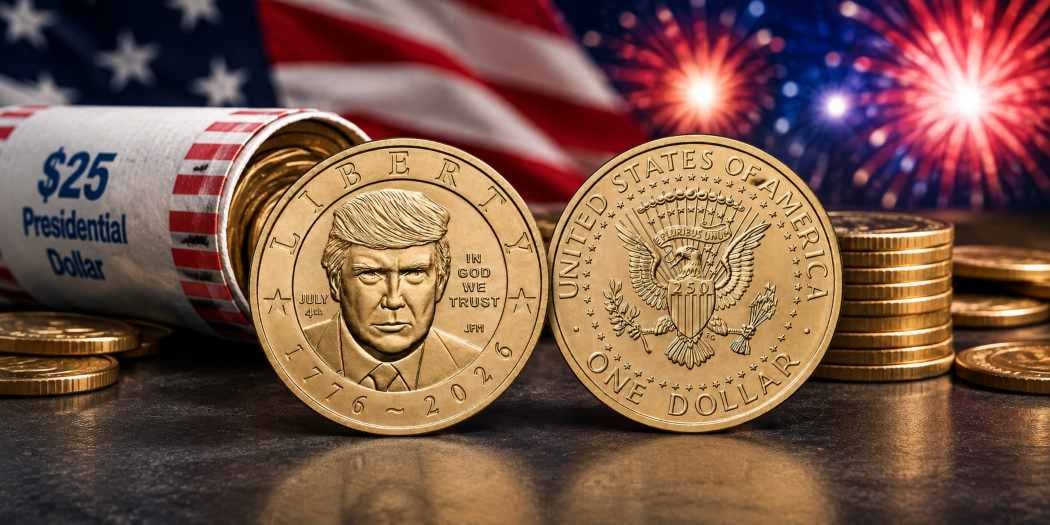
Collectors usually know what they are buying when the U.S. Mint releases a limited coin. The 2026 President Donald J. Trump dollar reverses that expectation. Beginning September 2, Mint rolls and bags contain a chance—not a promise—of yielding one of 250,000 dollars struck on July 4 with a special JULY 4th privy mark.
That distribution method makes the privy issue more interesting than its mintage alone suggests. Every special coin was produced at the Philadelphia Mint on Independence Day during the nation's 250th anniversary year, but the pieces were not reserved for a separate collector product. Instead, the Mint randomly inserted them among ordinary circulating-finish Trump dollars in 25-coin rolls and 100-coin bags. The result is a modern rarity whose total supply is already known while its location remains deliberately uncertain. For collectors, September 2 is therefore less a conventional product launch than the opening of a search.
The Mint Borrowed an Idea From Pocket Change
The concept did not begin with the Trump dollar. Earlier this summer, the Mint created 250,000 Declaration of Independence quarters bearing their own July 4 privy and mixed them into normal circulation. Banks and financial institutions received the coins without a map showing where the marked pieces had gone. The program turned an anniversary design into a nationwide treasure hunt, encouraging people to inspect change rather than simply order a commemorative product.
The Trump dollar carries that experiment into a different setting. Its privy coins are randomly distributed through numismatic rolls and bags purchased directly from the Mint rather than released broadly through normal commercial circulation. A buyer knows the possible hiding places but not whether a particular package contains a marked coin. One roll might produce a find while another might contain only standard examples; the same uncertainty applies to the larger bags.
That distinction also prevents the 250,000 mintage from being treated like a conventional edition limit. The Mint is not offering 250,000 individually identified privy coins to 250,000 buyers. Collectors have to locate them inside a much larger population. Scarcity exists at the production level, while discovery is left to chance.
A Discovery Coin Revealed the Secret Before the Mint Did
The story became unusual before the public search even started. A July 4th privy Trump dollar surfaced before the Mint had publicly explained the special production run. Heritage Auctions senior numismatist Rene Alvarenga found the piece in an Advanced Delivery roll, giving collectors their first widely reported look at a variety whose purpose and population were still unknown.
CAC Grading certified that example MS64 and identified it as the Discovery Coin and an Advanced Delivery piece. The small privy appears on the obverse beside the portrait, with JULY positioned above 4th. At that point, collectors could see that the coin differed from the standard issue, but they could not yet know whether it was a tiny experimental run, a broader anniversary variety or something else.
The Mint resolved those questions on August 27. It confirmed that exactly 250,000 of the privy dollars had been struck at Philadelphia on July 4 and would be interspersed throughout the rolls and bags. That chronology gives the first certified example a distinction beyond grade: it preserves the moment when the physical coin reached the hobby before the program behind it was fully public.
The Dollar Connects Two Very Different Anniversary Traditions
The privy may be the feature collectors search for first, but the underlying Trump dollar is historically unusual even without it. American coinage has generally avoided depicting living political leaders, making the portrait of a sitting president immediately conspicuous. The earlier Presidential $1 Coin Program specifically excluded living presidents, but the 2026 dollar comes from different statutory authority created for the Semiquincentennial.
Its design also places the coin firmly within the 250th-anniversary program. Chief Engraver Joseph Menna designed the obverse from an official White House photograph by Daniel Torok. Along with the portrait appear LIBERTY, IN GOD WE TRUST and the dual date 1776 ~ 2026. The reverse uses the Presidential Seal, adapted from work by former Chief Engraver Frank Gasparro, with 250 incorporated into the shield.
There is a century-old numismatic parallel. Sitting President Calvin Coolidge appeared beside George Washington on the 1926 Sesquicentennial of American Independence half dollar. That coin marked America's 150th anniversary; the Trump dollar arrives exactly 100 years later for the 250th. Coolidge's appearance did not establish a lasting tradition, which is precisely why the 2026 portrait stands out. The two anniversary coins bookend a century in which sitting presidents on U.S. coinage remained exceptional.
Finding One Is Only the Beginning of the Market Story
The Trump dollar contains no precious metal. Its golden appearance comes from a copper-based alloy, and the coin has a face value of one dollar. Any premium attached to the July 4th version will therefore be driven by numismatic factors rather than melt value.
The first question is distribution. Although 250,000 examples exist, random insertion means collectors cannot assume that buying a sealed roll or bag will produce one. Once substantial quantities are opened, the hobby should gain a clearer sense of how frequently the marked pieces appear in individual products. The next question will be condition. Circulating finish does not mean the coins have entered circulation, but contact during production and packaging can still matter when collectors begin competing for high certified grades.
Certification populations may eventually become more revealing than the headline mintage. If large numbers survive in similar condition, the market could treat the privy primarily as an accessible anniversary variety. If top-grade examples prove difficult, condition rarity could create a second layer of scarcity within the fixed 250,000-piece population. Early prices alone will not settle that question, particularly while supply is still entering collectors' hands.
The Hunt May Become the Coin's Most Memorable Feature
Modern Mint programs often create scarcity by limiting how many pieces can be ordered. The July 4th Trump dollar uses a different mechanism: the Mint has disclosed the number of special coins but withheld certainty from the individual purchase. That makes opening the package part of the collecting experience.
It also gives the issue a narrative that can survive beyond release day. The variety was discovered before its production story was announced, all 250,000 pieces were struck on Independence Day, and collectors must distinguish them from standard Trump dollars one coin at a time. Those circumstances intersect with an already unusual presidential portrait and the broader experiment in privy-marked circulating coinage during America's Semiquincentennial.
Whether the July 4th privy develops a substantial long-term premium will depend on demand, grade distribution and the secondary market. Its place in the 2026 program is easier to identify. The Mint has transformed a fixed mintage into a search, making uncertainty—not merely scarcity—the feature that defines how collectors encounter the coin. In that sense, the most important number may not be 250,000 at all. It may be the unknown number of unopened rolls and bags still waiting to reveal where those special Independence Day strikes actually landed.
FAQs
How many July 4th privy Trump dollars were struck?
The U.S. Mint struck exactly 250,000 President Donald J. Trump $1 coins with the July 4th privy mark. The special pieces were produced at the Philadelphia Mint on July 4, 2026, and have a circulating finish with no mint mark. Rather than selling the privy version separately, the Mint randomly mixed the coins into Trump dollar rolls and bags, making the fixed mintage only one part of their collectible appeal.
Where can collectors find the 2026 Trump dollar privy?
Collectors can find the July 4th privy variety randomly mixed into 2026 Trump dollar rolls and bags sold by the U.S. Mint. The Mint offers 25-coin rolls and 100-coin bags containing circulating-finish Philadelphia dollars, but it does not guarantee a privy coin in any individual package. Buyers therefore have to inspect each coin's obverse and look beside the presidential portrait for the small two-line JULY 4th device.
Is a July 4th privy guaranteed in every Trump dollar roll?
No, the U.S. Mint does not guarantee a July 4th privy coin in every Trump dollar roll or bag. The 250,000 special pieces were randomly interspersed among standard 2026 Trump dollars, so individual products may contain one, multiple examples or none. That uncertainty is central to the collecting experience. A sealed Mint package provides an opportunity to search for the variety, but it should not be treated as confirmation that a marked coin is inside.
What makes the July 4th Trump dollar different?
The July 4th Trump dollar carries a small privy mark identifying a limited group of coins struck at Philadelphia on Independence Day 2026. Only 250,000 received the special device, while standard Trump dollars do not carry it. The marked pieces otherwise share the circulating finish and basic design of the regular issue. Their combination of a specific production date, fixed population and random distribution distinguishes them within the broader Semiquincentennial dollar program.
Is the 2026 Trump dollar made from precious metal?
No, the 2026 Trump dollar is not made from gold, silver, platinum or palladium. Its golden appearance comes from a copper-based composition containing zinc, manganese and nickel, and its denomination is one dollar. Consequently, a July 4th privy example's potential premium is based on numismatic demand rather than intrinsic precious-metal value. Condition, certification, collector interest and the eventual distribution of high-grade examples could all influence how the secondary market values the variety.
Why is Calvin Coolidge relevant to the 2026 Trump dollar?
Calvin Coolidge provides a rare historical precedent because he appeared on a U.S. coin while serving as president. The 1926 Sesquicentennial of American Independence half dollar paired Coolidge with George Washington during the nation's 150th-anniversary celebration. One hundred years later, the Trump dollar places another sitting president on coinage created for a major anniversary of American independence. The parallel helps show how unusual living presidential portraits have remained within the broader history of United States coins.