


Why the 1964 and 1965 Washington Quarters Still Matter
At first glance, every U.S. quarter may seem identical—simply worth 25 cents. However, for collectors and precious metals investors, certain quarters carry significantly greater value. The transition between the 1964 and 1965 Washington Quarters represents one of the most important shifts in U.S. coinage history. This change not only altered the metal composition of circulating coins but also created a clear dividing line between intrinsic value and fiat currency. Today, the difference between these two coins extends beyond appearance, influencing both the silver spot price relationship and long-term collectibility. Understanding this transition helps investors recognize how everyday coins can connect directly to the broader precious metals market.
The 1964 Washington Quarter: America’s Final 90% Silver Issue
The 1964 Washington Quarter holds a special place in numismatics as the last circulating U.S. quarter struck with 90% silver. Prior to 1965, U.S. coinage relied heavily on silver, making these coins both functional currency and a store of value. Each 1964 quarter contains approximately 0.1808 troy ounces of pure silver, giving it intrinsic worth tied directly to the silver spot price today.
Because of this, the value of a 1964 quarter fluctuates with the precious metals market rather than remaining fixed at face value. These coins are often categorized as “junk silver,” a term used for circulated silver coins valued primarily for their metal content rather than rarity. Their historical significance as the final silver quarter further enhances demand among collectors. For investors seeking affordable exposure to physical silver, these coins remain a practical and widely traded option.
The 1965 Washington Quarter: The Shift to Clad Currency
The year 1965 marked a fundamental turning point in U.S. monetary policy. With rising silver prices placing pressure on production costs, the U.S. Mint transitioned to a copper-nickel clad composition for quarters and dimes. Unlike its predecessor, the 1965 Washington Quarter contains no silver, consisting instead of layered metals designed for durability and cost efficiency.
This shift was driven by increasing hoarding of silver coins, as their melt value began to exceed their face value. By removing silver from circulation, the government aimed to stabilize the coin supply and reduce production expenses. While the design remained nearly identical, the intrinsic value disappeared entirely. As a result, most 1965 quarters hold only their face value unless they feature rare minting errors.
How to Quickly Identify Silver vs Clad Quarters
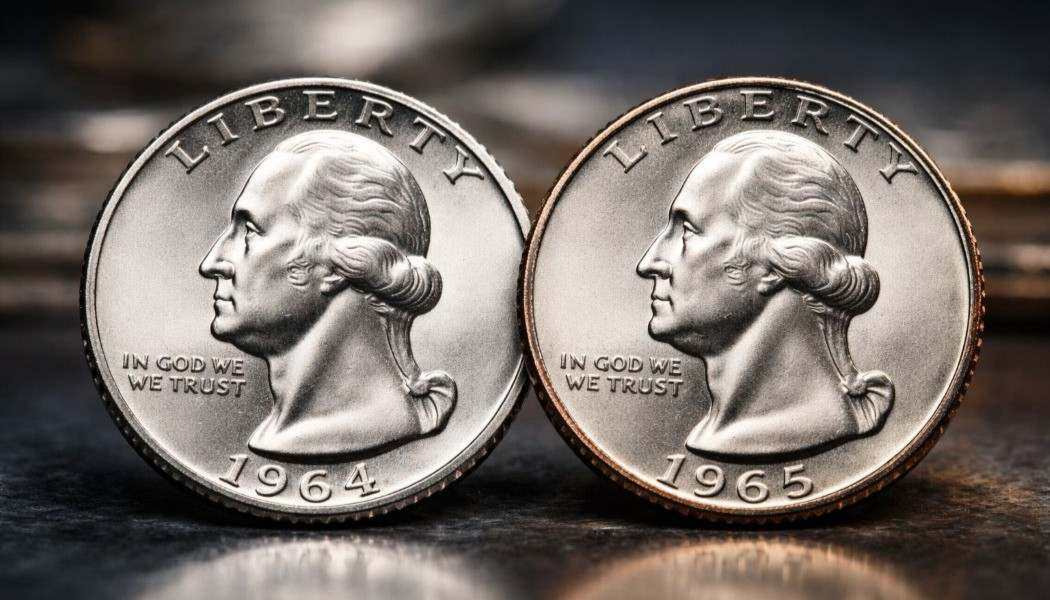
Despite their similar appearance, distinguishing between a 1964 and 1965 quarter is straightforward with a few simple checks. The most immediate indicator is the date, as 1964 marks the final year of silver content.
Another reliable method is examining the coin’s edge. Silver quarters display a uniform, bright metallic edge, while clad coins reveal a distinct copper-colored stripe. Weight also provides a clear distinction, as 1964 silver quarters weigh approximately 6.25 grams, while 1965 clad quarters are lighter at about 5.67 grams due to their copper-nickel composition.
For investors tracking the silver price today, this ability to identify silver coins is essential. Many valuable coins still circulate unnoticed, offering opportunities to acquire silver at face value in rare cases.
Rare 1965 Errors: When Clad Coins Gain Value
Although standard 1965 quarters lack precious metal content, certain rare mint errors can significantly increase their value. A small number of coins were accidentally struck on leftover silver planchets, creating highly sought-after transitional errors. These coins can command substantial premiums when authenticated by grading services such as PCGS or NGC.
Other notable errors include doubled dies and off-center strikes, which attract collector interest due to their uniqueness. However, these cases are relatively rare, and the vast majority of 1965 quarters remain standard circulation coins. For most investors, the primary focus remains on pre-1965 silver issues.
Why Silver Quarters Remain Popular with Investors
1964 Washington Quarters continue to be one of the most accessible ways to invest in physical silver. Their value is directly linked to the silver spot price, making them a tangible hedge against inflation and currency fluctuations. Unlike larger bullion products, these coins offer flexibility and divisibility, allowing investors to buy or sell in smaller increments.
Additionally, their widespread recognition ensures strong liquidity in both local and global markets. Many investors appreciate the combination of historical significance and intrinsic value, which adds depth beyond standard silver bullion bars. As interest in precious metals grows, silver quarters remain a reliable entry point for both new and experienced investors.
A Defining Moment in U.S. Coinage
The transition from the 1964 to the 1965 Washington Quarter represents more than a simple change in composition—it reflects a broader shift in how money is defined and valued. While the two coins may appear nearly identical, their underlying worth differs dramatically.
The 1964 quarter stands as a lasting example of silver-backed currency, offering both historical importance and investment potential. In contrast, the 1965 quarter marks the beginning of modern fiat coinage, where face value replaces intrinsic metal content.
For those interested in the relationship between everyday currency and the precious metals market, this comparison highlights the enduring appeal of silver. Even a small coin can carry significant value when backed by tangible assets.
Related reading you may find interesting:
Valuable U.S. Quarters: Rare Coins & Collector Insights