


Why the $100 Bill Remains a Cornerstone of U.S. Currency
The U.S. $100 bill, widely known as the “Benjamin,” represents one of the most trusted and globally recognized forms of currency. Since its debut in 1862, it has served as a symbol of financial strength, stability, and international confidence in the U.S. dollar. While modern investors closely monitor assets like the gold spot price and silver spot price for wealth preservation, the $100 bill continues to hold relevance as both a circulating medium and a collectible artifact. Its long-standing presence in global trade and finance has elevated it beyond simple paper currency into a historical and economic icon.
From Early Banknotes to Today’s High-Tech Currency
The journey of the $100 bill reflects the evolution of American monetary design and security innovation. Early issues from the Civil War era featured elaborate engravings and symbolic imagery, far different from today’s familiar format. In 1929, the U.S. standardized currency size, introducing the smaller notes still used today and cementing Benjamin Franklin as the central figure.
Major milestones in the bill’s development include:
-
Pre-1929 Notes: Large-format designs with intricate artwork
-
1929 Series: Standardized size and portrait format
-
1996 Update: Introduction of modern anti-counterfeiting elements
-
2013 Redesign: Advanced features like the 3D ribbon and color-shifting ink
Each redesign reflects the need to balance aesthetic tradition with modern security advancements.
The Significance of Benjamin Franklin on the $100 Bill
Unlike most U.S. currency, the $100 bill does not feature a president. Instead, it showcases Benjamin Franklin, a Founding Father whose contributions to science, diplomacy, and governance helped shape the nation. His image symbolizes intelligence, innovation, and fiscal responsibility—qualities closely associated with financial stability.
For collectors and enthusiasts, Franklin’s presence adds depth and meaning to the note. His legacy enhances both the historical narrative and the appeal of the $100 bill within the broader numismatic and paper currency market.
Advanced Security Elements in Modern $100 Bills
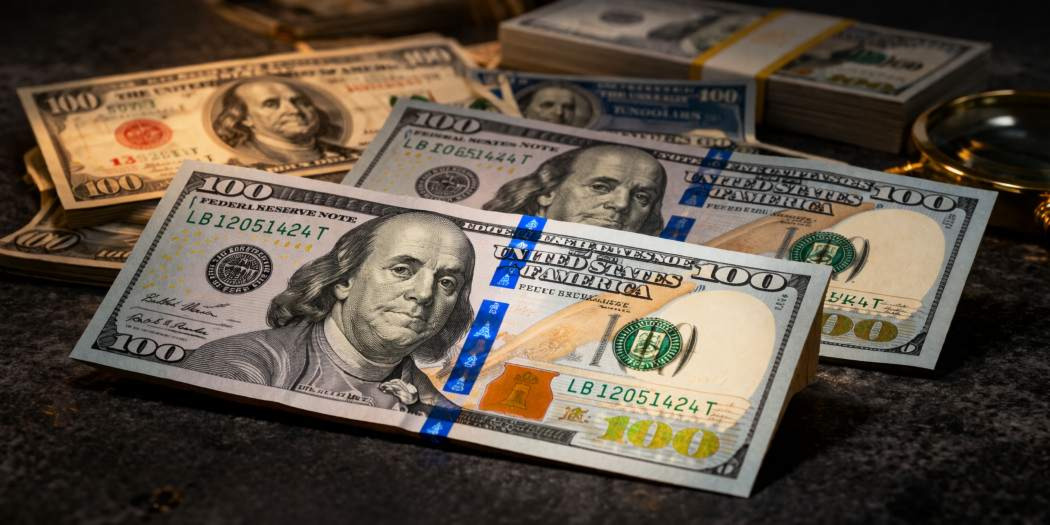
Today’s $100 bill incorporates sophisticated features designed to combat counterfeiting while maintaining visual elegance. These innovations make it one of the most secure banknotes in circulation.
Notable security features include:
-
3D Blue Security Ribbon: Displays shifting patterns when tilted
-
Color-Changing Ink: The numeral “100” transitions from copper to green
-
Bell in the Inkwell: A hidden image revealed through movement
-
Watermark and Embedded Thread: Visible under light or UV inspection
-
Microprinting: Fine details that resist duplication
These elements work together to ensure authenticity while preserving the bill’s classic design.
How to Verify an Authentic $100 Bill
Although the $100 bill features advanced technology, knowing how to check these elements in everyday situations is essential. Because of its high denomination, it is a frequent target for counterfeit attempts.
To confirm authenticity:
-
Tilt the bill to see motion within the blue security ribbon
-
Observe the color shift in the lower-right “100”
-
Feel for raised ink on the portrait and lettering
-
Hold the note to light to reveal the watermark
-
Use UV light to detect the glowing security thread
-
Inspect microprinting for clarity and precision
Genuine notes exhibit sharp detail, consistent alignment, and high-quality printing. Any irregularities may indicate the need for further verification.
Understanding Seal Colors and Their Meaning
The seals printed on $100 bills offer insight into their classification and historical context. Different seal colors correspond to specific types of U.S. currency issued over time.
-
Red Seals: Found on early United States Notes, now scarce
-
Blue Seals: Associated with Silver Certificates once redeemable for silver
-
Green Seals: Standard Federal Reserve Notes still in use today
Collectors often seek out specific combinations of seals, series dates, and signatures, as these factors can significantly influence value.
Identifying Rare and Valuable $100 Bills
While most $100 bills retain their face value, certain examples can command substantial premiums due to rarity or unique characteristics.
Key factors that increase value include:
-
Early Silver Certificates and Red Seal notes
-
Star notes with replacement serial numbers
-
Bills with low serial numbers or printing errors
-
Uncirculated notes in pristine condition
Exceptional pieces, particularly those with rare errors or historical significance, have achieved impressive auction results, demonstrating the potential of collectible currency.
How to Evaluate and Research Your Note
Determining the value of a $100 bill requires careful comparison and research. Collectors should reference recent auction sales and professional grading standards to assess their note accurately.
Important evaluation criteria include:
-
Series year and type of seal
-
Serial number uniqueness
-
Overall condition and grading quality
-
Presence of printing anomalies
Third-party grading services such as PMG and PCGS Banknote provide authentication and grading, enhancing both credibility and resale value.
Protecting Your Investment Through Proper Storage
Preserving the condition of a collectible $100 bill is essential for maintaining its value. Even minor damage can significantly impact desirability in the collector market.
Best practices include:
-
Storing notes in protective, archival holders
-
Avoiding exposure to light, heat, and humidity
-
Minimizing handling to prevent wear
Just as investors safeguard assets tied to the silver spot price today or fluctuations in the gold market, proper care ensures long-term preservation of paper currency.
Why Collectors Continue to Pursue $100 Bills
For many enthusiasts, collecting $100 bills offers a unique perspective on American financial history. Each series reflects a specific era, showcasing changes in design, technology, and monetary policy.
Beyond their collectible appeal, $100 bills hold global importance as a widely accepted store of value. Their connection to broader financial systems, including precious metals markets and currency stability, adds to their significance.
A Timeless Representation of Value and Innovation
The U.S. $100 bill stands as a powerful blend of history, artistry, and technological advancement. From its origins in the 19th century to its modern, security-rich design, it represents more than currency—it embodies trust in the U.S. financial system.
Whether viewed as a collectible, a historical artifact, or a functional asset, the $100 bill offers lasting relevance. As investors continue to track indicators like the gold spot price and diversify into tangible assets, understanding the role of paper currency provides valuable insight into the broader world of wealth preservation and financial history.
FAQs: U.S. $100 Bill
How do you check if a $100 bill is real?
Look for the 3D security ribbon, color-shifting ink, watermark, raised printing, and UV security thread—all must be present and clearly visible.
What is the blue strip on a $100 bill used for?
The blue strip is a 3D security ribbon woven into the paper that displays moving images when tilted, helping prevent counterfeiting.
Are all $100 bills still valid today?
Yes, all U.S. $100 bills remain legal tender regardless of their age or design.
What makes a $100 bill valuable to collectors?
Low serial numbers, star notes, printing errors, rare seal types, and uncirculated condition can significantly increase value.
What is a star note on a $100 bill?
A star note is a replacement bill marked with a star in the serial number, often produced in smaller quantities and sought after by collectors.
Do $100 bills have a watermark?
Yes, modern $100 bills include a watermark of Benjamin Franklin visible when held up to light.
When was the current $100 bill design released?
The latest design was introduced in 2013 and includes advanced anti-counterfeiting features.
Can a $100 bill be worth more than face value?
Yes, rare or error notes, especially in high-grade condition, can sell for hundreds or even thousands of dollars.
Why does the $100 bill change color when tilted?
The color-shifting ink in the “100” changes from copper to green to deter counterfeiting.
Is collecting $100 bills a good investment?
While most are worth face value, rare notes with unique features can appreciate significantly over time.