



How Tiny Gold Marks Protect Buyers in a High-Price Market
Gold jewelry hallmarks have become increasingly important as gold spot prices remain elevated and buyers pay closer attention to authenticity, resale value, and purity verification. A small stamp inside a ring, bracelet, necklace, or pendant can help separate accurately marked gold from misleading claims, plated pieces, or jewelry with unclear metal content. In a market where even a small difference in karat purity can significantly affect value, understanding these marks gives buyers a practical advantage.
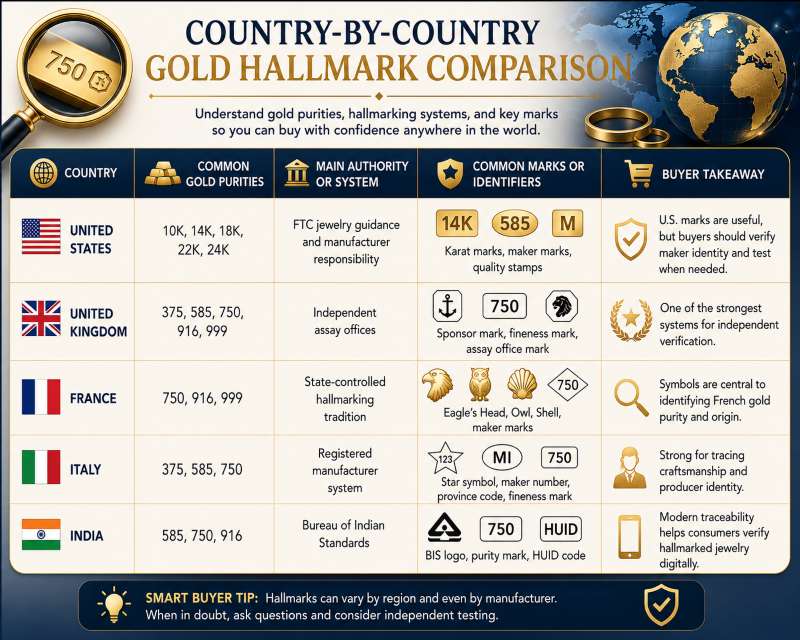
The challenge is that hallmark systems are not the same worldwide. The United States relies heavily on karat quality marks and manufacturer responsibility, while the United Kingdom uses independent assay offices. France depends on official symbolic marks, Italy combines purity marks with registered maker codes, and India has expanded its BIS hallmarking system with digital traceability. Together, these systems show how different gold markets verify value, protect consumers, and preserve trust.
The Small Stamps That Reveal Purity, Origin, and Trust
Gold jewelry hallmarks are marks, stamps, symbols, or codes that identify important details about a piece of jewelry. At the most basic level, they indicate purity. Common markings such as 10K, 14K, 18K, 22K, 375, 585, 750, and 916 show how much pure gold is present in the alloy. Because gold jewelry is usually mixed with other metals for strength and color, these marks help buyers understand what they are actually purchasing.
In many countries, however, hallmarks do more than show fineness. They can identify an assay office, a registered manufacturer, an importer, or a national certification authority. That additional information matters because two pieces with the same gold content may have very different market appeal depending on origin, craftsmanship, age, brand, and documentation. A clear hallmark can support authentication, while missing or suspicious marks may require professional testing.
How the United States Marks Gold Jewelry Differently
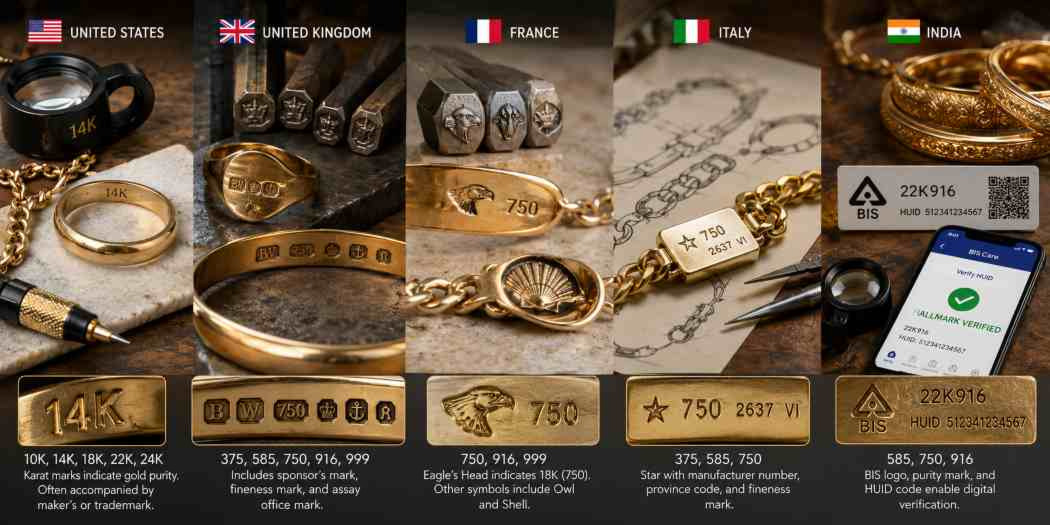
The United States does not use a traditional national assay office system like the United Kingdom. Instead, U.S. jewelry marking is largely based on quality marks, karat designations, and responsibility by the manufacturer or seller. A ring marked 14K, for example, indicates that the piece should contain 14 parts gold out of 24, or about 58.5% pure gold. A mark such as 18K indicates about 75% pure gold.
U.S. gold jewelry may also include a maker’s mark or trademark. This is important because quality marks should be connected to an identifiable party responsible for the accuracy of the claim. For buyers, that means a karat stamp alone is useful but not always enough. If a piece is valuable, old, damaged, imported, or purchased secondhand, professional testing can provide added confidence.
The U.S. system is practical and familiar, especially for modern commercial jewelry, but it places more responsibility on buyers, sellers, and appraisers to confirm authenticity.
Britain’s Assay Offices Set a High Standard for Verification
The United Kingdom has one of the most established hallmarking systems in the world. British hallmarking is built around independent testing through official assay offices, including London, Birmingham, Sheffield, and Edinburgh. This makes the system especially trusted among collectors, dealers, and estate jewelry buyers.
A typical British hallmark may include several elements: a sponsor’s mark identifying the party submitting the item, a fineness mark confirming purity, and an assay office mark showing where the piece was tested. Older pieces may also contain date letters or traditional symbols that help narrow down age and origin.
This layered structure gives British gold jewelry a strong authentication advantage. For buyers evaluating antique or vintage pieces, a complete British hallmark can provide more than purity confirmation. It can help establish provenance, period, and market confidence.
France’s Symbol-Based Marks Reflect a Luxury Tradition
French gold hallmarking is known for its use of official symbols rather than relying only on numbers. The Eagle’s Head mark is one of the most recognized French gold hallmarks and is commonly associated with 18-karat gold, or 750 fineness. Other marks, such as the Owl or Shell, may appear depending on the item’s origin, import status, or historical context.
This symbolic system reflects France’s long association with fine jewelry, luxury craftsmanship, and state-regulated precious metals. For collectors, French marks can be especially valuable because they may help distinguish domestic production from imported pieces or identify older estate jewelry.
The challenge is that French marks are often small and detailed. They may require magnification and comparison with reliable references. Still, when properly identified, they can strengthen confidence in both authenticity and market value.
Italy’s Maker Codes Connect Gold Jewelry to Craftsmanship
Italy is one of the world’s most influential gold jewelry manufacturing centers, known for chains, bracelets, designer pieces, and export-quality craftsmanship. Italian gold jewelry commonly carries a fineness mark such as 750 for 18-karat gold, along with a registered maker mark. This often includes a star symbol, a manufacturer number, and a provincial abbreviation.
Unlike systems focused primarily on assay office testing, Italy’s hallmark structure emphasizes traceability to registered producers. That matters because Italian gold jewelry is often valued not only for metal content but also for design quality, manufacturing skill, and regional production heritage.
For buyers, an Italian hallmark can help confirm both purity and origin. A properly marked 750 Italian bracelet, for example, signals 18-karat gold and may also connect the piece to a recognized manufacturing district. This combination of purity and craftsmanship keeps Italian marks highly relevant in the global jewelry trade.
India’s BIS and HUID System Modernize Gold Verification
India is one of the world’s most important gold jewelry markets, with gold deeply tied to weddings, savings, family wealth, cultural traditions, and long-term financial security. Because gold plays such a central role in household wealth, purity verification is especially important.
The Bureau of Indian Standards, or BIS, has expanded hallmarking rules to improve consumer protection and reduce misleading purity claims. Modern Indian hallmarked jewelry commonly includes the BIS logo, a purity mark such as 22K916, and a Hallmark Unique Identification code, known as HUID. This code allows buyers to verify details through official digital tools.
India’s system is significant because it combines traditional gold buying with modern traceability. As the Indian gold market continues to formalize, BIS hallmarking helps build trust between jewelers and consumers while reinforcing transparency in one of the largest physical gold markets in the world.
Purity Marks and Melt Value Are Only Part of the Story
A hallmark can confirm gold content, but jewelry value is rarely based on melt value alone. A plain broken chain may be valued mostly for gold weight and purity, while an antique French brooch, a signed Italian bracelet, or a British estate ring may carry additional premiums tied to craftsmanship, age, design, and collector demand.
This is where hallmark knowledge becomes especially useful. A 750 mark tells a buyer the piece is 18-karat gold, but an accompanying maker mark, assay mark, or country-specific symbol can provide deeper context. That context may affect resale value, insurance documentation, auction appeal, and buyer confidence.
At the same time, hallmarks should not be treated as absolute proof in every situation. Counterfeit marks exist, and older jewelry can be altered or repaired. Hallmarks are a strong first step, but higher-value pieces may still deserve professional evaluation.
Common Hallmark Mistakes Buyers Should Avoid
One of the most common mistakes is assuming every stamp is official. A mark that looks like 18K, 750, or 916 may indicate purity, but buyers should also consider the quality of the stamp, the presence of a maker’s mark, and whether the item matches the claimed origin. Poorly struck, inconsistent, or oddly placed marks can be warning signs.
Another mistake is confusing gold-plated marks with solid gold marks. Terms such as GP, GEP, HGE, RGP, and gold filled indicate layered or plated products rather than solid gold jewelry. These pieces may still have decorative value, but they should not be valued like solid gold items.
Buyers should also remember that different countries use different standards. A U.S. karat mark, British assay mark, French symbol, Italian registration code, and Indian HUID each require a different method of interpretation.
Future Gold Buying Will Reward Better Authentication
As gold remains a key store of value and online jewelry sales continue growing, hallmark literacy is becoming more than a collector skill. It is becoming a practical tool for anyone buying, selling, inheriting, or appraising gold jewelry. The more global the marketplace becomes, the more important it is to understand how different countries certify purity and origin.
The United States, United Kingdom, France, Italy, and India each show a different path toward trust. Some rely on independent assay offices, others on state symbols, registered makers, quality marks, or digital verification codes. For buyers, the best approach is not to memorize every possible mark, but to understand what the mark is supposed to prove.
A small stamp can reveal a great deal. In today’s market, that knowledge can help protect value, reduce risk, and bring more confidence to every gold jewelry purchase.
FAQs
What do gold jewelry hallmarks mean?
Gold jewelry hallmarks identify purity, origin, maker responsibility, or official verification, depending on the country. A hallmark may show karat content, such as 14K or 18K, or fineness, such as 585 or 750. In some countries, marks also identify assay offices, manufacturers, importers, or government certification systems. These marks help buyers confirm whether jewelry matches the seller’s description, although high-value items may still require professional testing.
Are gold hallmarks the same in every country?
Gold hallmarks are not the same in every country, which is why buyers should interpret them by origin. The United States commonly uses karat marks and maker responsibility, while the United Kingdom relies on independent assay office testing. France uses symbolic marks, Italy uses registered maker codes, and India uses BIS hallmarking with HUID traceability. These systems share the goal of verifying gold content, but their symbols, rules, and enforcement methods differ.
What do U.S. gold jewelry marks mean?
U.S. gold jewelry marks usually show karat purity, such as 10K, 14K, 18K, or 22K. These marks indicate the proportion of pure gold in the alloy. Many pieces also include a maker’s mark or trademark that identifies the company responsible for the quality claim. Because the United States does not use a single national assay office system for jewelry, buyers should verify valuable or secondhand items through reputable testing when needed.
How can I identify a British gold hallmark?
A British gold hallmark is usually identified by reading several marks together, including the sponsor’s mark, fineness mark, and assay office mark. The fineness mark confirms purity, while the assay office symbol shows where the item was tested. Older British jewelry may also include date letters that help identify the year of hallmarking. Because British hallmarking uses independent assay offices, these marks are widely respected for authentication.
What does the French Eagle’s Head hallmark mean?
The French Eagle’s Head hallmark generally indicates 18-karat gold, or 750 fineness. It is one of the best-known French gold marks and appears on many fine jewelry pieces made in France. French hallmarking often uses small official symbols, so magnification may be necessary for accurate identification. Collectors value these marks because they can help confirm purity, French origin, and sometimes the broader historical context of estate jewelry.
What do Italian gold hallmark numbers mean?
Italian gold hallmark numbers usually identify the registered manufacturer, while a separate fineness mark shows purity. Many Italian pieces include a star symbol, maker number, and province abbreviation, along with a mark such as 750 for 18-karat gold. This system helps trace jewelry to a registered producer. Italian marks are especially important because Italy is known globally for high-quality gold jewelry manufacturing, design, and export production.
What is a BIS hallmark on Indian gold jewelry?
A BIS hallmark is India’s official certification mark for gold jewelry purity. Modern BIS hallmarked jewelry usually includes the BIS logo, a purity mark such as 22K916 or 18K750, and a Hallmark Unique Identification code, known as HUID. The HUID system allows buyers to verify hallmarked jewelry through official tools. This added traceability helps protect consumers in one of the world’s largest gold jewelry markets.
What do 375, 585, 750, 916, and 999 mean on gold?
The numbers 375, 585, 750, 916, and 999 indicate gold purity in parts per thousand. A 375 mark means 37.5% pure gold, or 9-karat gold. A 585 mark equals 14-karat gold, while 750 equals 18-karat gold. A 916 mark indicates approximately 22-karat gold, and 999 represents very high-purity gold. These fineness numbers are widely used internationally and help buyers compare purity across different markets.
Can gold jewelry be real without a hallmark?
Gold jewelry can be real without a hallmark, especially if it is older, handmade, imported, repaired, or produced in a country with different marking rules. However, the absence of a hallmark makes authentication more difficult. Buyers should not assume unmarked jewelry is fake, but they should be cautious. A professional jeweler, assayer, or precious metals dealer can test the item to confirm gold content and help estimate value.
Do hallmarks increase the value of gold jewelry?
Hallmarks do not increase the melt value of gold, but they can improve market confidence and resale potential. A clear hallmark helps verify purity, origin, and sometimes maker identity, which can be important for antique, designer, or collectible jewelry. For ordinary scrap gold, weight and purity matter most. For estate or luxury pieces, hallmarks may support authentication, provenance, insurance documentation, and stronger buyer interest.