



Why ETF Flows Have Become One of the Market's Most Watched Indicators
There was a time when precious metals investors primarily focused on mine production, jewelry demand, central-bank reserves, and physical bullion sales. Those factors still matter, but the modern market moves far faster than it did a generation ago. Today, capital can enter or leave the gold and silver markets in enormous quantities within a matter of hours, and much of that movement occurs through exchange-traded funds.
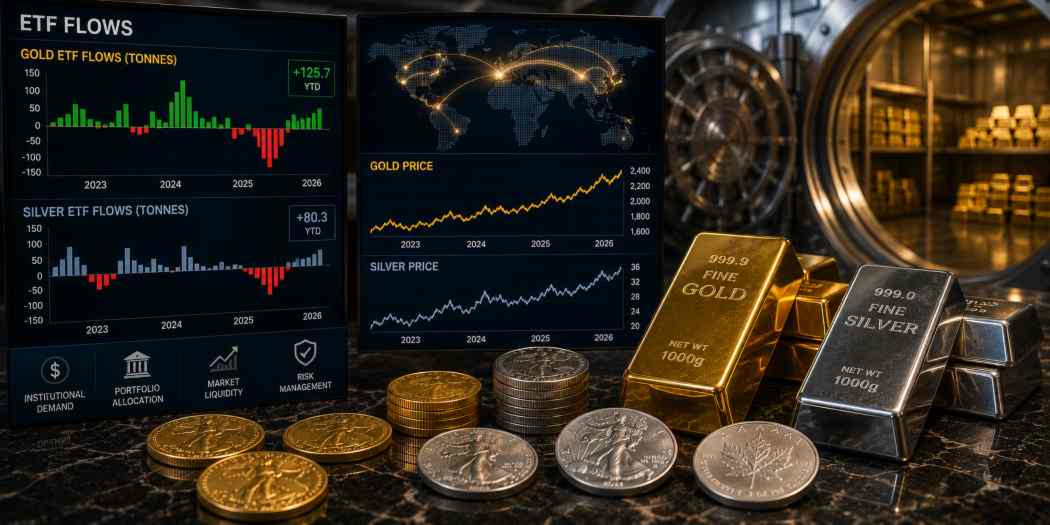
This shift has fundamentally changed how investors interpret precious metals demand. ETF flows are published regularly, tracked closely by analysts, and often cited as evidence of either growing conviction or fading enthusiasm. Large inflows can generate bullish headlines. Significant outflows frequently spark concerns about weakening demand. Yet the relationship between ETF activity and the underlying health of the precious metals market is far more nuanced than many investors assume.
The challenge is that ETF flows are highly visible while many other forms of demand are not. Central-bank purchases often emerge with a delay. Private bullion accumulation can be difficult to measure. Industrial consumption trends take time to appear in official statistics. ETF activity, by contrast, offers near-immediate insight into how institutional capital is positioning. That visibility has elevated ETF flows into one of the market's most influential indicators, but it has also encouraged investors to place too much weight on them in isolation.
ETFs Changed How Investors Access Precious Metals
The rise of precious metals ETFs transformed access to gold and silver in ways that would have been difficult to imagine several decades ago. Before ETFs became widely available, investors seeking meaningful exposure typically had two choices: purchase physical metal or trade futures contracts. Both approaches carried complexities that limited participation.
ETFs created a middle ground. Investors could gain exposure through traditional brokerage accounts, avoiding the logistics of storage and the leverage associated with futures markets. The simplicity of that structure attracted both retail investors and institutions, dramatically expanding the pool of capital capable of moving into precious metals.
That accessibility also accelerated the speed at which sentiment can influence markets. A pension fund adjusting allocations, a hedge fund reducing risk exposure, or a wealth manager responding to economic developments can all express those views quickly through ETFs. The result is a market where investment demand can shift far more rapidly than physical supply or industrial consumption.
Understanding that distinction is essential because ETF flows often reflect changing expectations rather than changing fundamentals. Investors are not necessarily reacting to what has happened; they are positioning for what they believe may happen next.
Gold ETF Flows Often Reflect Macro Thinking More Than Gold Demand
One reason gold ETF activity receives so much attention is that it frequently serves as a real-time gauge of investor attitudes toward the broader economy. Gold's role as a monetary asset means its demand is closely tied to expectations surrounding inflation, interest rates, currency movements, and financial stability.
When investors become concerned about economic uncertainty, declining real yields, geopolitical tensions, or currency debasement, gold ETFs often attract significant inflows. The metal's appeal as a defensive asset encourages capital to move quickly into the sector, particularly among institutions seeking efficient exposure.
The opposite dynamic can emerge when confidence improves. Rising real yields, stronger economic growth, or increasing appetite for risk assets can encourage investors to reduce gold allocations. ETF outflows frequently accompany these shifts, but interpreting those outflows requires caution. A reduction in ETF holdings does not necessarily indicate that investors have abandoned gold altogether. It may simply reflect a temporary adjustment in portfolio positioning.
This distinction matters because ETF activity often reveals what investors are thinking about the economy rather than what they think about physical gold itself. In many cases, the flow data serves as a proxy for broader macroeconomic sentiment.
Silver ETF Flows Tell a More Complicated Story
Silver introduces an additional layer of complexity because it occupies a very different position within the precious metals landscape. Investors buy silver for many of the same reasons they buy gold, yet industrial demand accounts for a much larger share of the market.
This dual identity often makes silver ETF flows more difficult to interpret. An inflow into a silver fund may reflect inflation concerns, expectations for economic growth, optimism surrounding renewable energy deployment, or enthusiasm for technology-related demand. In many cases, several of those forces are operating simultaneously.
The rise of artificial intelligence infrastructure, expansion of electrical grids, growth in solar installations, and continued demand for advanced electronics have strengthened silver's industrial foundation. Investors allocating capital to silver ETFs increasingly evaluate both monetary and industrial narratives rather than relying exclusively on one or the other.
This is one reason silver often experiences larger swings than gold. When investors become optimistic about both economic growth and precious metals, ETF inflows can accelerate rapidly. When industrial expectations deteriorate, silver can face pressure even if broader interest in precious metals remains relatively healthy.
Why ETF Outflows Are Not Always Bearish
Market commentary often treats ETF outflows as an unmistakably negative signal. The logic seems straightforward: money is leaving the sector, therefore demand must be weakening. Reality is rarely that simple.
Investors withdraw capital from ETFs for many reasons that have little to do with long-term views on precious metals. Portfolio rebalancing, profit-taking, risk management, and changing asset-allocation targets can all produce significant outflows. A large institutional investor may reduce exposure after a strong rally without fundamentally altering its long-term outlook.
Gold offers numerous examples of this phenomenon. Periods of ETF selling have occasionally occurred alongside robust central-bank purchases, strong retail bullion demand, or resilient physical markets. In those cases, the visible decline in ETF holdings attracted headlines even though broader demand remained healthy.
The lesson is not that ETF outflows are irrelevant. Rather, it is that they should be interpreted as one data point among many. Context often matters more than the flow itself.
Physical Buyers and ETF Investors Frequently Operate on Different Timelines
One of the most revealing aspects of modern precious metals markets is how differently physical buyers and ETF investors respond to the same set of circumstances.
Institutional investors often react quickly to economic reports, central-bank announcements, and changing market expectations. ETFs allow them to adjust exposure within minutes if necessary. Their focus is frequently tactical, emphasizing liquidity and portfolio management.
Physical bullion buyers tend to approach the market from a different perspective. Many purchase gold and silver to preserve purchasing power, diversify assets, or reduce exposure to financial-system risks. Their decisions are often measured in years rather than weeks. As a result, they may continue accumulating metal even during periods when ETF investors are reducing exposure.
This divergence creates some of the market's most interesting signals. ETF holdings can decline while coin and bar demand remains strong. Physical premiums can rise even as futures prices weaken. Investors who focus exclusively on one side of the market risk missing important developments occurring on the other.
ETF Flows Can Influence Liquidity Without Changing Fundamentals
The sheer size of major gold and silver ETFs means their activity can influence market conditions even when underlying fundamentals remain unchanged.
Large inflows can absorb substantial quantities of metal, particularly in silver where the market is smaller and industrial demand already competes for available supply. Strong investment demand arriving through ETFs can tighten inventories and amplify price movements, especially when industrial consumption remains robust.
Outflows can produce the opposite effect, releasing metal back into investment channels and easing some of those pressures. Yet even in these situations, the broader supply-and-demand picture may remain largely intact. A temporary shift in investor positioning does not automatically alter long-term trends in mine production, industrial usage, or central-bank activity.
This distinction is important because investors often confuse liquidity-driven market moves with fundamental changes. ETF flows can accelerate price action without necessarily changing the underlying trajectory of the market itself.
Bullion and Collectibles Respond to ETF Trends in Different Ways
ETF flows are most relevant to products whose value is closely tied to underlying metal prices. Gold bars, silver rounds, and government-minted bullion coins generally move with the broader market, making them more sensitive to shifts in investor sentiment reflected through ETFs.
Collectible coins operate differently. Their value often depends on rarity, condition, certification, historical significance, and collector demand. While precious metals prices still influence the market, they are only one component of the valuation process.
This distinction becomes especially important during periods of volatility. A rare numismatic coin may remain highly desirable even during ETF outflows, while a widely traded bullion product may respond more directly to changes in metal spot prices. Investors who understand these differences are better equipped to choose products that align with their objectives rather than assuming all forms of precious metals ownership respond identically to market developments.
The Most Valuable ETF Signal Is Often What It Confirms
One of the most common mistakes investors make is treating ETF flows as a forecasting tool. In reality, their greatest value often lies in confirmation rather than prediction.
A surge in inflows can reinforce evidence already emerging from other areas of the market. Rising physical demand, stronger industrial consumption, supportive monetary conditions, or increasing geopolitical uncertainty may all be reflected in ETF activity. Similarly, outflows can confirm changing sentiment that is already visible through bond yields, currency movements, or risk appetite.
Viewed in isolation, ETF data can be misleading. Viewed alongside central-bank purchases, physical premiums, industrial demand trends, futures positioning, and macroeconomic developments, it becomes far more useful. The flow itself is rarely the entire story. It is often one chapter within a much larger narrative.
Why ETF Activity Will Remain Central to Precious Metals Analysis
The influence of ETFs is unlikely to diminish anytime soon. They have become deeply embedded within the way investors access and evaluate precious metals, providing transparency and speed that few other market indicators can match.
For gold, ETF flows continue offering insight into how institutional investors are responding to inflation expectations, interest-rate trends, and broader economic uncertainty. For silver, they provide a window into a market where monetary demand increasingly intersects with industrial growth and technological investment.
The most informed investors recognize that ETF flows are neither a crystal ball nor a distraction. They are a valuable piece of market intelligence that becomes far more powerful when combined with other indicators. Understanding what ETF activity is saying—and what it is not saying—helps investors develop a more complete view of how precious metals markets are evolving.
In a market increasingly shaped by central-bank accumulation, industrial demand growth, shifting monetary policy, and geopolitical uncertainty, ETF flows remain one of the clearest signals available. The key is remembering that they reveal investor behavior, not necessarily investor certainty. Like every other market indicator, their true value lies in the context surrounding them.
FAQs
How do gold ETF flows affect gold prices?
Gold ETF flows affect gold prices by showing whether investors are adding or reducing exposure to the metal. Strong inflows can support prices because physically backed funds may need more gold holdings, reinforcing demand. Outflows can pressure prices by signaling reduced investor interest or profit-taking. However, gold also responds to central bank buying, real yields, the U.S. dollar, inflation expectations, and geopolitical risk.
What does silver ETF demand mean for the market?
Silver ETF demand shows how much investor capital is moving into exchange-traded silver exposure. When silver ETFs attract inflows, they can increase demand for physical metal backing and support price momentum. This matters because silver also has strong industrial demand from solar energy, electronics, power systems, and advanced technology. If ETF demand rises while physical supply remains tight, silver prices and premiums can become more sensitive.
What are ETF creations and redemptions?
ETF creations and redemptions are the processes that allow large authorized participants to add or remove ETF shares from the market. In many physically backed metals ETFs, creations may involve delivering metal or cash to the fund, while redemptions may remove shares and release metal or cash according to fund rules. This mechanism helps ETF share prices stay close to the underlying value of the metal.
Do ETF outflows mean gold demand is weak?
ETF outflows do not always mean overall gold demand is weak. They may reflect profit-taking, short-term macro positioning, rising yields, a stronger dollar, or portfolio rebalancing. Physical bullion demand, central bank purchases, jewelry consumption, and over-the-counter buying may remain strong even when ETF holdings decline. Investors should treat ETF outflows as one signal, not a complete measure of the entire gold market.
Are silver ETFs backed by physical silver?
Many major silver ETFs are designed to be backed by physical silver held in vaults, though structures differ by fund. Investors should review a fund’s prospectus to understand custody, fees, redemption rules, and whether it holds physical metal or uses derivatives. Physical silver ETFs can provide convenient price exposure, but they are not the same as owning coins or bars stored directly by the investor.
How do ETF flows affect bullion premiums?
ETF flows can affect bullion premiums indirectly by changing wholesale metal demand and liquidity. Strong ETF inflows may absorb metal while retail demand also rises, potentially tightening supply and supporting higher premiums. Outflows may increase metal availability, but premiums still depend on mint capacity, product type, shipping costs, dealer inventory, and retail demand. Spot prices and physical premiums can move differently during volatile markets.
Why do institutions use metals ETFs?
Institutions use metals ETFs because they provide liquid, exchange-traded exposure to gold or silver without requiring direct storage, insurance, shipping, or authentication. ETFs allow fast portfolio adjustments, risk management, and tactical positioning around inflation, currency movements, interest rates, and geopolitical events. They are convenient for large allocations, but they do not offer the same direct ownership characteristics as physical bullion held personally.
Are gold ETFs better than physical gold?
Gold ETFs are better for liquidity and convenience, while physical gold is better for direct ownership and tangible asset control. ETFs can be bought and sold quickly through brokerage accounts, making them useful for tactical exposure. Physical gold requires storage and may include premiums, but it has no fund structure or share redemption dependency. The better choice depends on an investor’s goals, timeline, and preference for access.
Do ETF flows affect silver more than gold?
ETF flows can affect silver more sharply than gold because the silver market is smaller and more industrially sensitive. When ETF demand rises alongside strong fabrication demand, available supply can tighten quickly. Gold has a deeper and more liquid global market, including central banks and large over-the-counter trading. Silver’s smaller market size can make investor flows more visible in price action and physical premiums.
Should bullion investors track ETF flows?
Bullion investors should track ETF flows because they reveal institutional positioning, liquidity trends, and short-term sentiment in gold and silver markets. ETF inflows can support price momentum, while outflows may warn of changing investor appetite. However, physical buyers should also watch spot prices, premiums, product availability, central bank demand, industrial consumption, and real yields before making purchase decisions.