


How NYC Gold Sales Tax Works and When You Pay Nothing
Understanding NYC gold sales tax is one of the most overlooked—but financially important—parts of buying precious metals in New York. The key rule is straightforward: purchases of qualifying gold, silver, platinum, and palladium are fully exempt from sales tax when the total transaction exceeds $1,000.
If the total falls below that threshold, the entire purchase becomes taxable at New York City’s combined rate, which exceeds 8%. With the gold spot price and other metals fluctuating in response to inflation, interest rates, and global demand, structuring a purchase correctly can make a meaningful difference in total cost.
The $1,000 Threshold: Why Structure Matters More Than Price
New York’s exemption rule is binary—there is no partial benefit.
-
$1,000 or more → 100% tax-free
-
$999.99 or less → fully taxable
This “all-or-nothing” structure is what makes the rule so powerful—and so often misunderstood. Buyers sometimes assume that only the amount below $1,000 is taxed, but that is incorrect. The entire transaction either qualifies or does not.
This creates a unique opportunity: even a small adjustment to a purchase can eliminate sales tax entirely.
What Actually Qualifies Under New York Precious Metals Law
Not every product marketed as gold or silver automatically meets exemption criteria. For a purchase to qualify, it generally must consist of investment-grade precious metals.
Common qualifying items include:
-
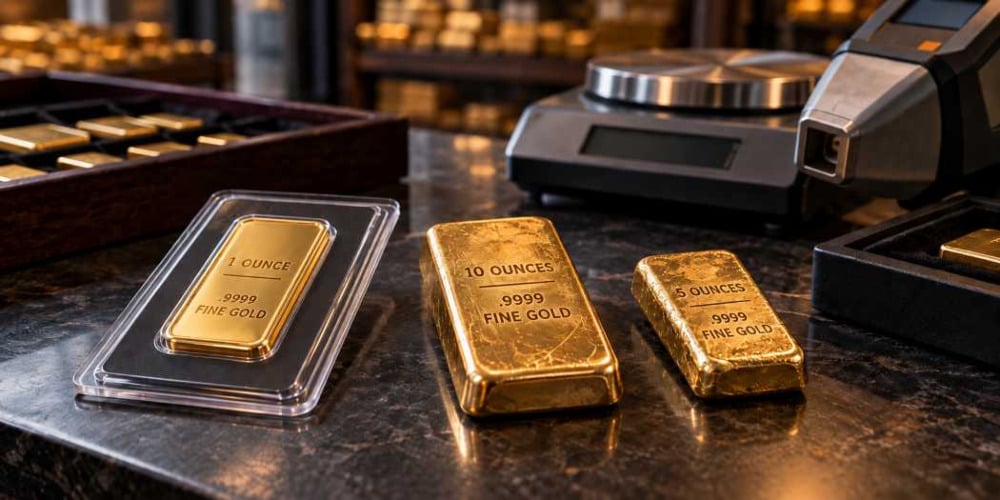
Gold, silver, platinum, and palladium bullion bars
-
Widely recognized bullion coins
-
Certain numismatic coins that meet purity and classification standards
Examples typically include:
-
Canadian Silver Maple Leafs
-
Gold and silver bars from major refiners
However, products with high collectible premiums or significant non-metal value may be treated differently depending on how they are categorized.
NYC vs State Tax: Why Location Still Matters
The exemption itself is governed by New York State law, but New York City applies one of the highest combined sales tax rates in the country.
This means:
-
Sub-$1,000 purchases are subject to full NYC sales tax (~8%+)
-
Qualified purchases above $1,000 are completely exempt
For buyers, this creates a clear incentive to structure transactions properly—especially in a high-tax environment like NYC.
Real-World Example: How Buyers Save Instantly
Consider two purchases:
-
Buyer A purchases $980 in silver → pays full NYC sales tax
-
Buyer B adds one additional coin, bringing total to $1,020 → pays zero tax
The difference is not marginal—it is immediate and significant.
At current pricing levels, this can mean saving:
-
$70–$85+ per transaction
-
More on larger purchases
This is why experienced buyers often plan purchases around the threshold, not just around price movements.
Timing Purchases with Market Prices
Because precious metals prices fluctuate daily, the $1,000 threshold becomes easier or harder to reach depending on market conditions.
-
When gold prices rise → fewer items are needed to qualify
-
When silver prices fall → buyers may bundle products to exceed the threshold
This creates a tactical layer to buying:
-
Watching price dips
-
Combining items strategically
-
Timing purchases around both price and tax efficiency
In practice, tax awareness becomes part of the overall investment strategy, not just a logistical detail.
Common Buyer Mistakes That Lead to Unnecessary Tax
Even experienced investors can misstep when navigating NYC gold sales tax rules.
The most common errors include:
-
Splitting purchases into multiple transactions below $1,000
-
Assuming all “gold” or “silver” products qualify
-
Misunderstanding the all-or-nothing threshold
-
Not considering tax when building a cart
These mistakes can turn what should be a tax-free purchase into a fully taxable one.
Edge Cases: Mixed Orders and Product Classification
One of the more nuanced areas involves mixed carts—orders that include both qualifying and non-qualifying items.
In some cases:
-
The entire order may still qualify if it meets exemption standards
-
In others, certain items may trigger tax depending on classification
Because of this complexity, working with a knowledgeable dealer becomes important. Proper categorization can determine whether a transaction qualifies for exemption.
How NYC Compares to Other States
New York sits in a middle position nationally when it comes to precious metals taxation.
Other states may:
-
Fully exempt all bullion regardless of purchase size
-
Apply no exemption at all
-
Use more complex rules tied to product type or form
New York’s system is simpler—but more strategic. It rewards purchase planning, rather than offering automatic exemption.
Why Tax Efficiency Matters More in Today’s Market
In a market influenced by inflation, interest rate expectations, and geopolitical developments, every cost component affects overall returns.
Sales tax directly impacts:
-
Entry price
-
Cost basis
-
Long-term profitability
For investors accumulating positions over time, avoiding unnecessary tax can significantly improve outcomes.
Strategic Buying: How to Maximize the Exemption
Experienced buyers approach NYC gold sales tax with a clear strategy:
-
Plan purchases to exceed $1,000
-
Monitor pricing to optimize timing
-
Bundle products when needed
-
Work with reputable dealers who understand classification
This approach transforms tax rules from a limitation into an advantage.
Forward Perspective: Smart Structuring in a High-Cost Environment
As precious metals continue to attract interest amid inflation concerns and economic uncertainty, New York’s tax structure remains highly relevant.
The key takeaway is simple—but powerful:
how you buy matters just as much as what you buy.
By understanding and applying the $1,000 exemption correctly, investors can:
-
Reduce costs
-
Improve efficiency
-
Strengthen long-term positioning
In today’s environment, that level of precision is not optional—it is a core part of disciplined bullion investing.
Related reading you may find interesting:
Gold Leasing and Lending: Institutional Basics