


Two Precious Metals, Two Very Different Markets
When gold rallies, many investors assume platinum will follow.
The logic seems straightforward. Both are precious metals. Both are traded globally. Both are viewed as stores of value during periods of economic uncertainty. Yet a glance at their long-term price charts tells a different story. There are years when platinum and gold move almost in lockstep, and others when they head in completely opposite directions.
That divergence isn't unusual—it reflects the fact that platinum lives in two worlds at once.
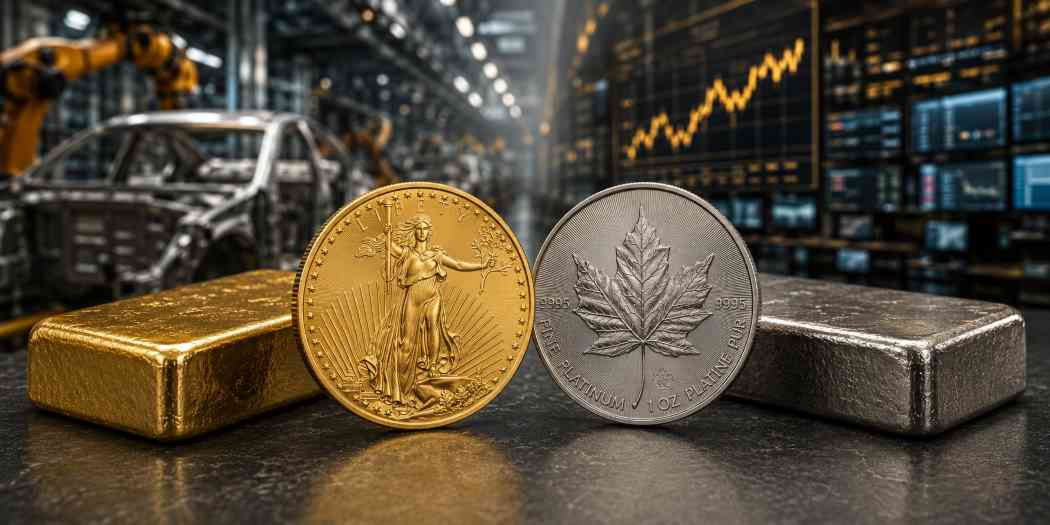
Like gold, platinum attracts investment demand during periods of financial stress and inflation concerns. Unlike gold, however, it is also an industrial metal whose fortunes are closely tied to manufacturing, automotive production and broader economic activity. Which side of its personality dominates depends on what is driving the market at the time.
Understanding that distinction is one of the keys to interpreting platinum prices. Investors who watch only gold often miss the factors that matter most to platinum, while those who focus solely on industrial demand can overlook the moments when it begins behaving like a traditional safe-haven asset.
There Are Times When Platinum Closely Tracks Gold
During periods of heightened uncertainty, platinum often benefits from the same investor psychology that supports gold.
When financial markets become volatile, inflation accelerates or geopolitical tensions increase, investors frequently look toward tangible assets with intrinsic value. Gold typically receives most of the attention, but platinum can also attract inflows simply because it belongs to the precious metals complex. Exchange-traded products, bullion coins and investment bars all become more appealing as investors diversify beyond traditional financial assets.
Interest-rate expectations also influence both metals. Higher interest rates generally strengthen the opportunity cost of holding non-yielding assets, creating headwinds for precious metals as a group. Conversely, expectations for lower rates or easier monetary policy can improve sentiment across gold, platinum and silver simultaneously.
Those shared macroeconomic influences explain why the two metals occasionally appear highly correlated. Yet that relationship often proves temporary because platinum has another, equally important source of demand that gold simply doesn't.
The Industrial Economy Often Takes Control
If gold's primary driver is investment demand, platinum's is industrial consumption.
For decades, the automotive industry has represented one of platinum's largest end markets. The metal plays a critical role in catalytic converters, where it helps reduce harmful vehicle emissions. Demand therefore rises and falls alongside automobile production, emissions regulations and changes in engine technology rather than investor sentiment alone.
That industrial exposure creates price movements that would seem unusual in the gold market. A slowdown in vehicle manufacturing, weaker global economic growth or declining factory output can pressure platinum prices even as the gold spot price benefits from safe-haven buying. At other times, recovering industrial activity may lift platinum while gold loses momentum as investors become more willing to embrace risk.
The same dynamic extends beyond automobiles. Platinum is widely used in chemical processing, petroleum refining, electronics, glass manufacturing and an expanding range of hydrogen fuel-cell technologies. Each sector contributes its own layer of demand, making platinum one of the few precious metals whose price reflects both financial markets and the real economy.
Platinum's Supply Story Is Unlike Any Other Precious Metal
Demand is only half of the equation. Platinum's supply is unusually concentrated, and that concentration can have an outsized impact on prices.
Roughly three-quarters of the world's newly mined platinum originates in South Africa, with much of the remaining production coming from Russia and Zimbabwe. Unlike gold, which is mined across dozens of countries, platinum depends on a relatively small number of major producers. That makes the market particularly sensitive to labor disputes, electricity shortages, mine closures and geopolitical developments affecting those regions.
South Africa provides a good example. Rolling power outages, rising production costs and aging mining infrastructure have periodically constrained output over the past decade. When supply tightens while industrial demand remains healthy, platinum can rally even if gold is moving in the opposite direction. The reverse is also true. If automotive demand weakens during an economic slowdown, reduced consumption can outweigh supply concerns and pressure prices despite constrained mine production.
For investors, this creates a market where company news, mining reports and industrial surveys can sometimes matter more than central bank policy.
Platinum Doesn't Compete With Gold—It Competes With Other Metals
Another reason platinum frequently breaks away from gold is that it rarely exists in isolation.
Automakers have long balanced platinum and palladium in catalytic converter production, substituting one for the other when economics and engineering allow. As the price gap between the two metals changes, manufacturers often adjust their purchasing strategies, creating demand shifts that have little connection to broader precious metals markets.
Hydrogen technology has introduced another potential source of long-term demand. Platinum plays a role in proton exchange membrane fuel cells and certain electrolyzer technologies used to produce green hydrogen. Although this sector remains much smaller than automotive demand today, many analysts view it as an area capable of supporting future consumption as hydrogen infrastructure expands.
Jewelry also contributes to the equation. Platinum remains especially popular in markets such as China and Japan, where changing consumer preferences can influence physical demand. None of these factors meaningfully affect gold, which is why platinum's price often responds to industry-specific developments while gold continues trading primarily on macroeconomic themes.
What Platinum Investors Should Watch
Investors sometimes make the mistake of treating platinum as a cheaper version of gold. In reality, understanding platinum requires watching a broader set of indicators.
Gold investors often begin with interest-rate expectations, central bank policy, inflation data and movements in the U.S. dollar. Those variables certainly influence platinum as well, but they rarely tell the whole story. Manufacturing activity, global vehicle production, emissions regulations, South African mining conditions and developments in hydrogen technology frequently have just as much influence over platinum's direction.
That combination makes platinum more cyclical than gold. During periods of robust industrial growth, platinum can outperform many other precious metals. During economic contractions, however, weakening industrial demand may offset safe-haven buying that would normally support the broader precious metals sector.
Rather than asking whether platinum will follow gold, investors may find a better question is this: What is driving platinum today? The answer changes far more often than it does for gold, and recognizing that shift is one of the most important steps toward understanding how the platinum market really works.
FAQs
Does platinum always follow gold prices?
No. Platinum sometimes moves in the same direction as gold during periods of heightened market uncertainty, inflation concerns or changing interest-rate expectations. However, platinum is also an important industrial metal, so its price is heavily influenced by manufacturing activity, automotive demand and mine supply. Those additional drivers often cause platinum to outperform or underperform gold for extended periods.
Why is platinum considered both a precious metal and an industrial metal?
Unlike gold, which is primarily purchased for investment and jewelry, platinum has extensive industrial applications. It is widely used in catalytic converters, petroleum refining, chemical production, electronics and emerging hydrogen technologies. Because industrial consumption represents a significant share of overall demand, platinum prices often reflect economic growth and manufacturing trends alongside investor sentiment.
What factors have the biggest impact on platinum prices?
Several factors influence platinum prices, including global automobile production, industrial manufacturing, mine supply, interest-rate expectations and investor demand. Supply disruptions in South Africa, where most of the world's platinum is mined, can have a particularly significant impact. Changes in emissions regulations and technological developments affecting platinum consumption also play important roles in shaping the market.
Why is South Africa so important to the platinum market?
South Africa produces roughly three-quarters of the world's newly mined platinum, making it the dominant supplier. As a result, labor disputes, electricity shortages, operational challenges and mining disruptions in the country can quickly affect global platinum availability. Because production is concentrated in relatively few regions, platinum prices are often more sensitive to supply disruptions than gold prices.
Is platinum more volatile than gold?
Historically, platinum has tended to experience greater price volatility than gold. Its dependence on industrial demand means prices can respond sharply to changes in global economic activity, vehicle production and manufacturing trends. Gold, by comparison, is generally driven more by investment demand, monetary policy and safe-haven buying, which often results in different price behavior during economic cycles.
How does the automotive industry affect platinum prices?
The automotive industry remains one of platinum's largest sources of demand because the metal is used in catalytic converters that help reduce vehicle emissions. When vehicle production increases or emissions standards become stricter, platinum demand often strengthens. Conversely, weaker automobile sales or changing technologies can reduce industrial consumption and place downward pressure on prices.
Can platinum outperform gold?
Yes. Platinum has periodically outperformed gold when industrial demand strengthened or mine supply tightened. Supply constraints in South Africa, recovering manufacturing activity or increased demand from the automotive sector can all support platinum prices even during periods when gold is relatively stable. Market leadership between the two metals has shifted numerous times over the past several decades.
Is platinum a good diversification investment?
Many investors include platinum as part of a diversified precious metals portfolio because it responds to different market drivers than gold. While gold is primarily viewed as a monetary and safe-haven asset, platinum offers exposure to industrial growth alongside precious metals ownership. Combining both metals may provide broader diversification across changing economic and market conditions.
Should investors watch gold or industrial data more closely?
Both matter, but their importance changes over time. During periods of financial uncertainty, platinum may closely follow gold as investment demand increases. In stronger economic environments, however, industrial indicators such as manufacturing activity, automotive production, mine supply and hydrogen technology developments often become more influential in determining platinum's direction.